


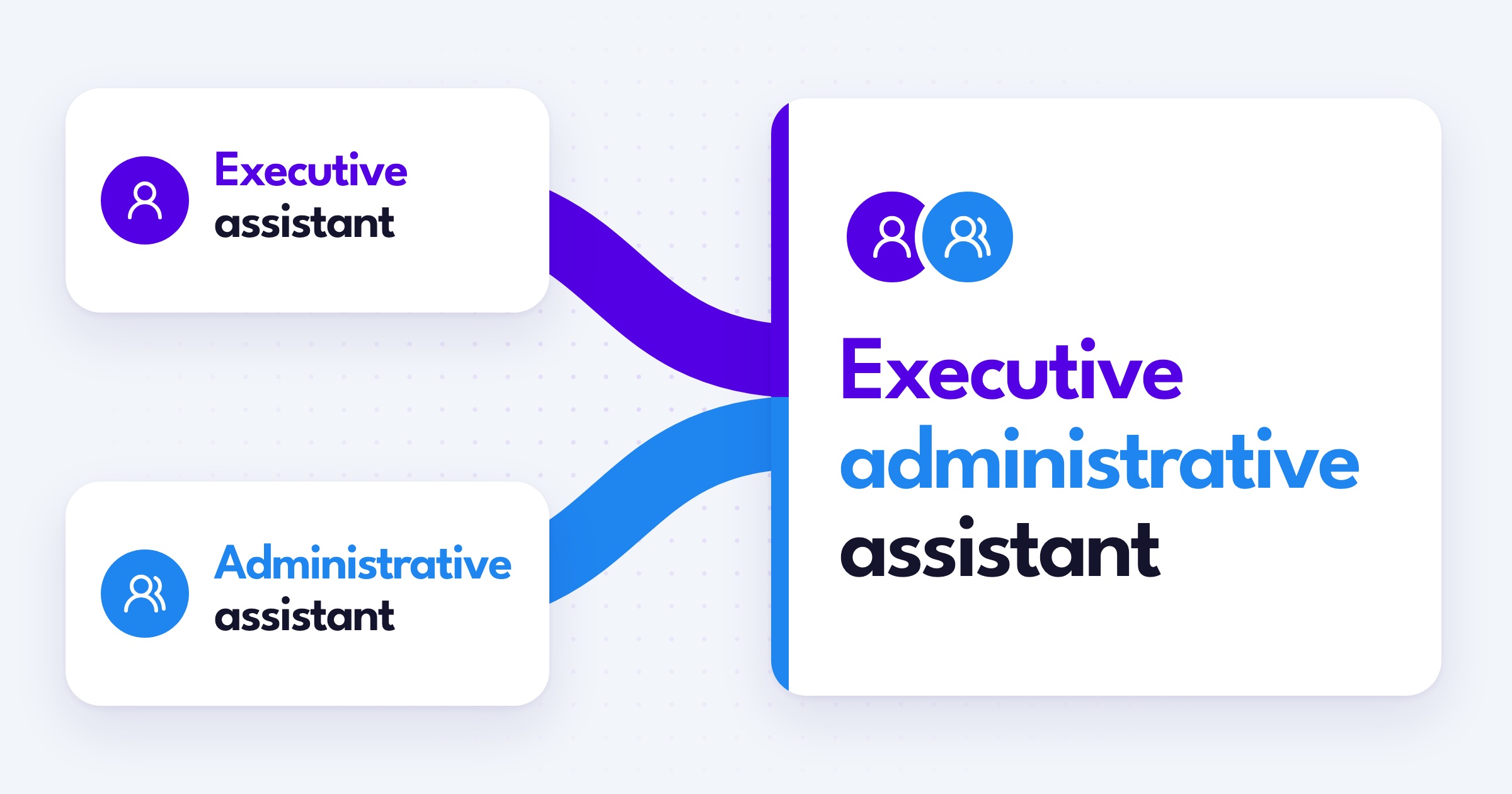
An executive assistant and an executive administrative assistant sound like the same job, and businesses oftentimes use the titles interchangeably. These two roles are not the same, though. There are tasks that executive administrative assistants are in charge of that an executive assistant does not do, like keeping calendars for several leaders at once, managing vendors, and running the office’s day-to-day operations.
Below, we break down how the role compares to an executive assistant and an administrative assistant, what you should consider when hiring one, and what to expect when you get an executive administrative assistant on the team. Magic places all types of assistants, and we’re here to help you find the right one.
- An executive administrative assistant blends two jobs: supporting senior leaders like an executive assistant, and running administrative work for the team or organization like an administrative assistant.
- An executive assistant is usually a one-on-one strategic partner to a single executive. An administrative assistant usually supports a whole department or team.
- Judge a role by its scope more than its title. Companies use these titles interchangeably.
What is an executive administrative assistant?
An executive administrative assistant is a hybrid role that blends the responsibilities of an executive assistant and an administrative assistant. They support one or more senior leaders, such as a CEO, CFO, or VP, while also doing administrative work for the entire team or organization, including meetings, workflows, vendors, and office operations.
An executive assistant serves as a strategic partner to a single high-level officer, such as a CEO, CFO, or VP. An administrative assistant is often tasked with keeping the day-to-day admin work running for an entire team or organization, including meetings and workflows.
Being an executive administrative assistant means doing both: supporting C-level executives while doing administrative work for the entire organization. The word “executive” has its own merits, as the U.S. Bureau of Labor Statistics (BLS) groups this title with executive secretaries.
According to the BLS, the median annual wage for executive secretaries and executive administrative assistants was $76,590 in May 2025. The BLS doesn’t track executive assistants as a separate job, so they are counted in this same group. For comparison, the median annual wage for administrative assistants was $47,540.
Executive administrative assistant vs. executive assistant vs. administrative assistant
These three job titles are pretty similar and, depending on the organization they work for, might even sometimes be interchangeable. Their main differences lie in the level at which they operate.
An executive assistant and an executive administrative assistant both work directly with executives, as it says in their job titles. An administrative assistant will work with the rest of the organization, such as HR, recruitment, and IT. To get a better understanding of the difference between these three jobs, we created a comparison table below.
| Feature | Administrative assistant | Executive assistant | Executive administrative assistant |
|---|---|---|---|
| Primary focus | Keeping the office and the organization running smoothly | Supporting C-level executives and managing their day-to-day | Attending to executives and the organization |
| Who they support | A whole department or team | C-level executives, VPs, directors, or leaders | Leaders and the organization, oftentimes both at the same time |
| Typical tasks | Data entry, filing, answering phones, ordering supplies, team scheduling | Calendar and inbox management, travel, meeting prep, acting on the executive’s behalf | Calendars for several leaders, reporting, vendor management, office operations |
| Role and autonomy | Follows the organization’s workflows and processes; direct task management from their supervisor | Can act as a proxy for the executive; more autonomous depending on their work dynamic with their boss | Depending on their task and where the directive came from, can be autonomous when it comes to C-level tasks |
| Typical experience | Entry level and up | Several years, often including admin roles | Several years, often including admin roles |
| Median annual salary (BLS, May 2025) | $47,540 | $76,590 (counted with executive administrative assistants) | $76,590 |
Just a quick note: some companies use these job titles interchangeably. It is important to know the difference between them, but keep in mind that you should judge a role by its scope more than its name.
Core duties of an EAA
An executive administrative assistant’s role has a broad scope of responsibilities. Apart from managing the daily calendar of executives, much like an executive assistant does, they also manage the organization’s overall workflows and processes, as needed. Some of their tasks include:
- Schedule management. Calendar and meeting management for multiple leaders, including the executives, directors, and managers.
- Travel and event coordination. Booking tickets, hotels, transportation, and managing travel schedules.
- Document preparation, reporting, and records management. Preparing meeting agendas, reports, and whatever the executive or the team needs for their everyday workflow.
- Communications and gatekeeping. Contacting internal employees and external vendors or affiliates, as needed by the business. They also filter calls and handle appointment setting to make sure the executive’s schedule is on track.
- Office or department operations. Managing vendors, supplies, onboarding logistics, and expense processing for the team.
Executive administrative assistant skills and qualifications
A “good” executive administrative assistant can be measured by their capability to be an executive’s dedicated assistant and an entire team’s administrative officer, often at the same time. Beyond that, their communication skills must be impeccable. There’s no room for misunderstanding when the job calls for talking to and from executives, teams, and vendors.
The hard skills they need include office suites, scheduling tools, content management systems, customer relationship management tools, basic bookkeeping and accounting, and adequate knowledge of social media and technology.
Apart from having great spoken communication skills, other soft skills would also be good if you’re considering hiring one. These may include discretion, level-headedness, prioritizing across several stakeholders, and clear written communication.

For background and experience, it’s up to you whether a degree and years of experience in the role are major requirements.
Typically, executives (or their headhunters) will want to hire one with extensive experience, so training and onboarding will not take as much time, since they’re already familiar with the role.
The screening process can get overwhelming. That’s where third-party hiring agencies will come in handy. Here at Magic, we screen every applicant based on your requirements and their qualifications. All that’s left to do is your final interview with them to see if they’re a good fit for your business needs.
Which role does your business actually need?
Here’s the short answer:
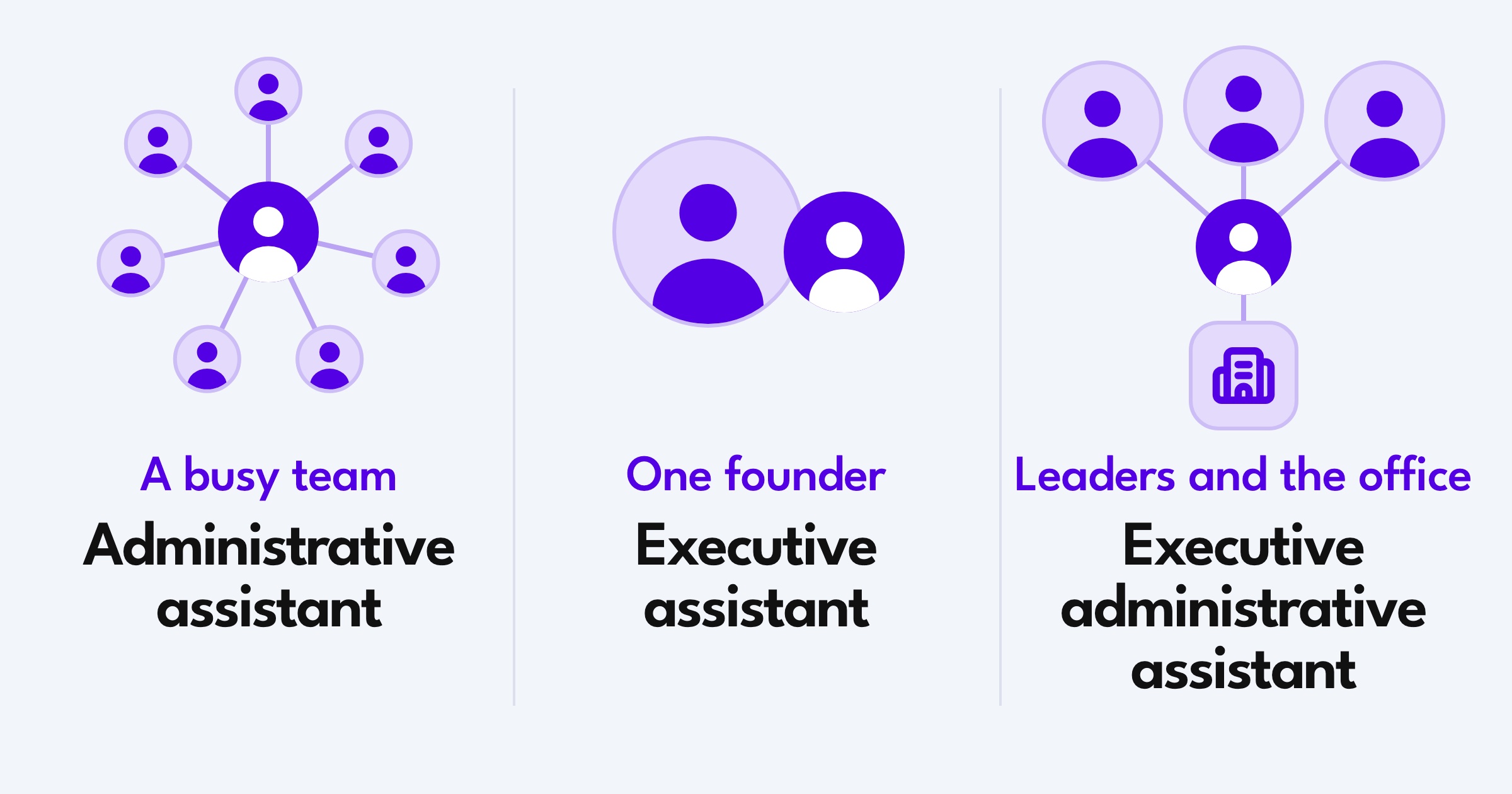
- High-volume admin work for a team or office: an administrative assistant.
- A strategic right hand for one founder or executive: an executive assistant.
- Support for several leaders plus office operations: an executive administrative assistant.
Needing a trusted assistant is something a lot of busy business owners can relate to. An assistant is someone who is one call away if you need help managing operations or someone to call a restaurant for reservations. Businesses can thrive thanks to the effective collaboration of executives or owners and their assistants.
However, sometimes, it takes time to find the right assistant for your specific business needs. Maybe yours needs a receptionist, a file manager, and an office manager, or anything that requires high-volume, high-traffic administrative work. An administrative assistant would be the better choice.
If you, as a founder, want a strategic right hand for your business and personal needs, someone who can help you with everything you need to keep everything running smoothly, an executive assistant is the right move for you.
Do you think you need a mix of both? An executive administrative assistant will practically run everything for you, save the big business decisions. You may also decide that you want an EA for now and later on upgrade to an executive administrative assistant. Business needs often change as the company grows, and that is perfectly fine.
Hiring an executive administrative assistant: in-house vs. remote
When hiring for a growing business, it is important to consider the logistics. More than the cost, logistics will tell you what amount of work can be done with the most value for your money. Employers save an average of $10,000 per employee per year in real estate costs with full-time remote work.
Practically speaking, remote work is the way to go for many businesses. You save money on office space; the talent pool is infinitely bigger (think the whole world if you want); and less time is wasted traveling to and from work, which means increased productivity. Even in a physical office, the bulk of the work is done online unless your industry is in the labor sector.
If that’s not enough to convince you to consider going full-remote (or partial for now, baby steps), we made a comparison table below.
| Feature | In-house | Remote |
|---|---|---|
| Primary cost | Commute, office space, and utilities | Home office setup (equipment), stable internet, and protective software |
| Work flexibility | Pros: Face-to-face discussions that leave little room for misunderstandings; faster team alignment
Cons: Need to be physically in the office at designated work hours; cannot leave unless on break |
Pros: Able to work anywhere, giving back more time both for you and your employee for personal tasks
Cons: Relies heavily on video meetings, calls, emails, and messages; less social interaction with the team, which can lead to isolation |
| Talent pool | Limited to applicants with your requirements and qualifications within the area; one pro is you can interview the applicant in person and get a better feel of who they are and what they can bring to the table | Global talent access with no limits unless you set it yourself; hiring employees halfway across the world is now possible |
| Annual salary cost | $76,590 median salary in the U.S. (BLS, May 2025), before benefits and office costs | Varies by location; a full-time Magic executive assistant is $540 a week, about $28,000 a year |
For a full breakdown, see our guide to how much an executive assistant costs.
If you go remote, Magic matches you with an assistant curated from the top 0.5% of talent, and you don’t pay until you’ve met them and decided to hire.
FAQs about executive administrative assistants
Is an executive administrative assistant the same as an executive assistant?
Not quite, though many businesses use the titles interchangeably. An executive assistant usually works one-on-one with a C-level executive, VP, or company leader as a strategic partner, often acting on their behalf.
An executive administrative assistant typically supports several senior leaders and handles more of the operational work around them. They can run point on calendars across teams, reporting, and overall office admin work. When comparing roles, you can look at the job description beyond the title.
Is an executive admin assistant a step up from an administrative assistant?
In most businesses, yes. An administrative assistant usually supports a team or office with general admin tasks. An executive administrative assistant supports senior leaders, which means doing more high-level work. Many of them started as administrative assistants.
Can one person handle both EA and executive admin duties?
Yes, especially at smaller companies. The executive administrative assistant will handle everything the boss needs while also making sure the organization side is running smoothly.
The challenge comes later as a business keeps growing. One person can end up stretched between being a leader’s right hand and keeping the office running. If priorities start slipping, that’s usually a sign it’s time to split the work between two roles.
Does an executive administrative assistant need a degree?
Not always. Many business owners hire them based on their experience, skills, and track record.
With that said, some larger corporate companies prefer executive administrative assistants with a bachelor’s or associate degree, or at the least, certifications in office administration. Strong soft skills like organizational and communication skills, and knowing how to use common business tools matter as much as having a college degree in this field of work.
Executive administrative assistant or executive assistant: which to hire
An executive assistant is a one-on-one strategic partner to a single leader. An executive administrative assistant supports several leaders and also keeps the team’s administrative work running. If you need both, an exec admin covers the two; if you mostly need a right hand, start with an executive assistant.
Magic places all types of assistants, and we’re here to help you find the right one. Get started with Magic and meet your assistant before you pay anything.
