


Business hours are more of a suggestion in the modern economy. When your website is open all night and your email inbox accepts messages around the clock, many customers will expect answers immediately.
This gap between expectation and reality costs businesses money, as speed directly dictates retention and revenue. While sub-one-hour email responses can achieve a 71% customer retention rate, the stakes are even higher for new sales. Research shows that 78% of customers buy from the first business to respond. If a high-value prospect submits an inquiry at 9:00 p.m. and your team doesn’t reply until morning, you have likely already lost the sale.
Bringing in outside help is the most practical way to close this gap. But securing 24/7 support involves more than following standard advice on how to find a virtual assistant. Because the objective is true round-the-clock coverage, you have to approach the evaluation process differently.
What “24/7 virtual assistant” actually means
When you start looking for an around-the-clock virtual assistant, you will quickly realize that providers deliver this coverage through very different operational models. You must understand these differences because your choice dictates how you will manage the workflow.
A dedicated night shift worker
This model relies on a single individual working odd hours to cover your nighttime operations. You hire someone located on the other side of the world, or someone working a dedicated graveyard shift in your local time zone.
The main advantage of this setup is familiarity. You train one person, they learn your business deeply, and they handle everything that happens after you go to sleep. The disadvantage, however, is that it also has a single point of failure. If this person gets sick, takes a vacation, or experiences a local power outage, your 24/7 coverage drops to zero.
A pooled or rotating team
Under this model, a team hands off tasks across different time zones to maintain continuous coverage. As one assistant finishes their eight-hour shift in the Philippines, they pass the active inbox and pending tasks to an assistant starting their shift in Latin America or Eastern Europe.
This setup eliminates the single point of failure. You get true 24-hour virtual assistant coverage without worrying about individual sick days. The drawback is that it requires rigorous documentation. If the handoff process is flawed, a customer issue might slip through the cracks during the shift change.
An AI-first layer with human backup
To account for the potential drawbacks in other setups, some modern agencies provide a hybrid approach by pairing the availability of artificial intelligence (AI) with human oversight.
An AI agent monitors your inboxes and chat widgets overnight. It automatically resolves simple queries like password resets or order status checks. If a request requires executive judgment or empathy, the AI escalates the ticket to an on-call human assistant.
This setup is highly cost-effective, but it gives you less control over the exact tone of the responses, and complex issues still wait in a queue until a human intervenes.
Domestic on-call escalation
Certain providers offer a localized, on-call model. Instead of a worker sitting at a desk for an entire eight-hour night shift, an assistant remains on standby to respond only to high-priority pages or emergency alerts.
This is common in IT and medical operations. You pay a lower retainer for the standby time, plus a premium hourly rate for active incident response.
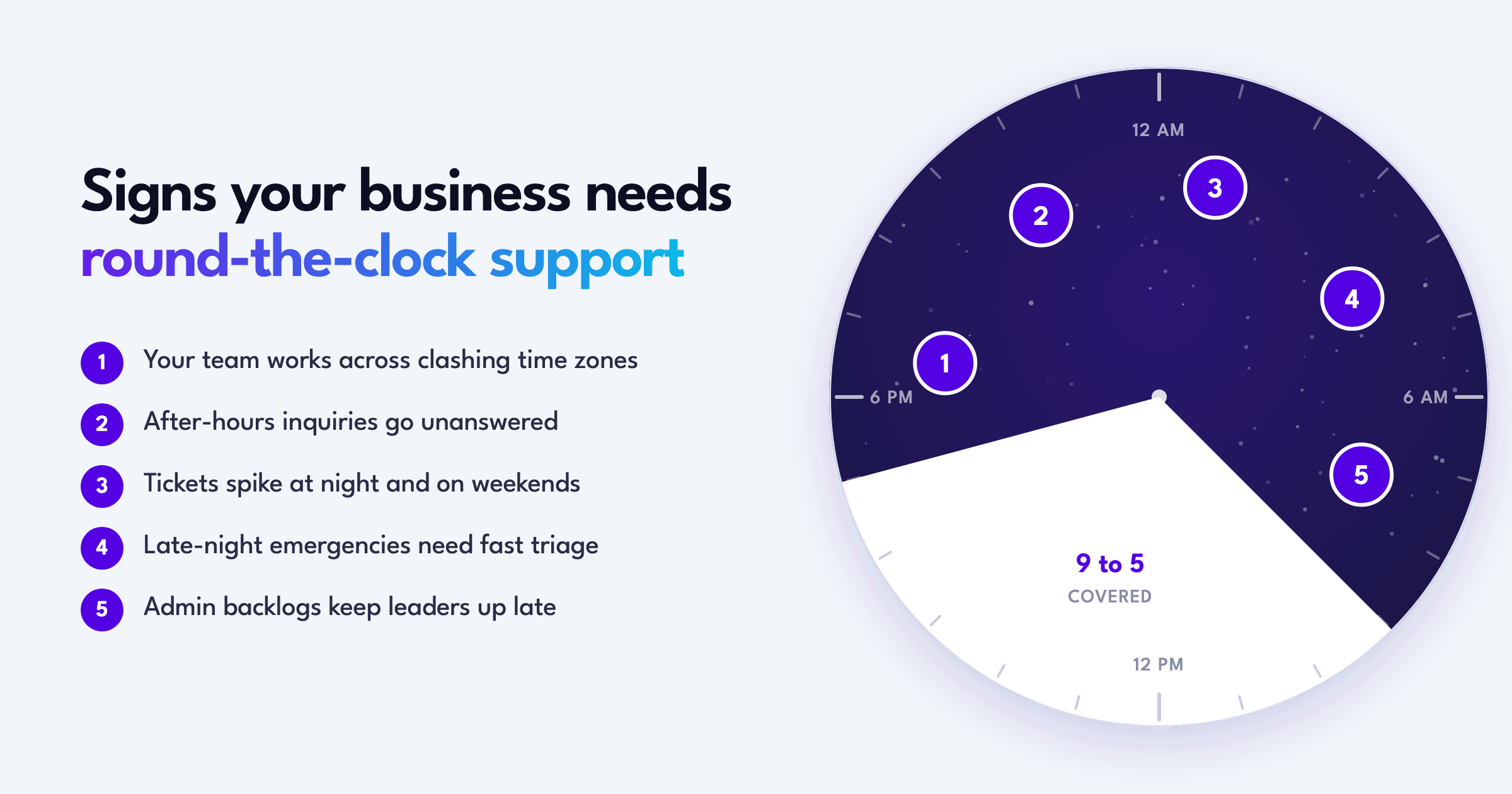
Signs your business actually needs round-the-clock support
Do not pay for a virtual assistant available 24/7 just because it sounds impressive. Many businesses run perfectly well on standard business hours support. If you simply need someone to organize your calendar, clean up your CRM, and filter your emails so you can start the next day fresh, a standard assistant is enough. If you go with this option, you can then start exploring answers to the question “what can a virtual assistant do?” to see if your needs fit a standard 9-to-5 profile.
However, standard support fails when time dictates revenue or operations. You genuinely need overnight virtual assistant coverage if your company experiences the following conditions:
1. Remote staff members operate across conflicting time zones.
Asynchronous work breaks down when minor roadblocks require real-time approval. If an overseas developer loses server access during their morning, they can waste an entire workday waiting for a U.S.-based project manager to log on and fix the permissions. An overnight assistant eliminates this operational drag by resolving immediate workflow issues as they arise.
2. Unanswered after-hours inquiries cost the business new sales.
If your sales data shows high drop-off rates for leads generated after 5:00 p.m., your response time is the problem. A Lead Response Management Study published in the Harvard Business Review found that businesses responding to leads within five minutes are 100 times more likely to make contact than those that wait 30 minutes.
You cannot hit that five-minute window at midnight with a local sales team. To maintain that speed after business hours, you need someone awake to capture the momentum. Night and weekend virtual assistant support answers those late-night questions and books sales calls onto your calendar, so you start the next day with warm prospects.
3. Customer support tickets surge at night and on weekends.
E-commerce businesses often see traffic surges on weekends, holidays, or during specific promotional events. If your current team logs off on Friday at 5:00 p.m., an angry customer with a missing package might leave a negative review on Saturday morning before anyone reads their email.
You need a mechanism to intercept that frustration in real time. A weekend virtual assistant catches urgent tickets as they arrive, resolving shipping issues before they escalate into public complaints.
4. Late-night logistical or technical emergencies require immediate triage.
An overnight virtual assistant actively monitors your dashboards and immediately pages the right personnel the second an alarm triggers. This constant triage is critical if you run a logistics company, a cybersecurity firm, or a property management business. In these industries, late-night emergencies are inevitable, and a single missed email about a server outage or a delayed freight shipment can easily cost thousands of dollars by morning.
5. Administrative bottlenecks force leadership into late-night shifts.
You cannot scale a company if you spend every evening firefighting customer issues and preparing pitch decks. Yet founders constantly fall into this trap, with nearly 40% working over 60 hours a week and 72% reporting burnout.
An overnight assistant breaks this cycle by clearing the administrative backlog while you sleep. This stops you from acting as the operational bottleneck and finally buys your time back.
What to evaluate when comparing providers
Once you confirm that your business suffers without round-the-clock coverage, you must vet the agencies offering to fix it. This requires looking far beyond their marketing materials.
A promise of 24/7 availability means very little if the provider relies on disorganized shift changes or lacks an escalation protocol. You are hiring for systemic reliability.
When you compare providers, you must audit the operational infrastructure that keeps their support running while you sleep. Focus your attention on these specific areas:
- The handoff mechanics: You need to know exactly how work transitions between shifts or team members. Ask the provider to show you their standard operating procedure for a shift change. If a customer emails at 11:55 p.m. and a new shift starts at midnight, you must know who owns that ticket.
- Familiarity versus rotation: Clarify whether you will work with the same dedicated group of assistants or a random rotating pool. Some agencies route your tasks to whichever worker is currently idle. You want a provider that assigns you a specific, dedicated team.
- Response-time guarantees: Never accept vague promises about fast replies. Ask for a specific Service Level Agreement (SLA). You need to know if they guarantee a first response within 15 minutes, one hour, or four hours.
- Handling sensitive requests: Establish rules for escalation. An assistant working at 3:00 a.m. needs to know what they can authorize on their own and what requires waking you up.
- Pricing models: Providers bill for 24/7 support through hourly rates, flat monthly retainers, or pooled block hours.
- Account continuity: People quit or take medical leave. Ask the provider how account continuity works if someone on your assigned team leaves.
Questions to ask before signing on
Translating operational requirements into a productive conversation is difficult when a sales representative controls the pitch.
Keep this checklist handy during your next meeting. These specific questions force the provider to move past their marketing claims and explain exactly how they handle real-world scenarios:
- “How exactly do handoffs work between team members during a shift change?”
- “What is your guaranteed response time for an urgent, after-hours request?”
- “If a customer issue requires executive judgment overnight, what is your specific escalation process?”
- “Am I billed at an hourly rate, a flat retainer, or through pooled hours?”
- “If an assistant on my account quits tomorrow, how do you handle the transition and continuity?”
Where round-the-clock support helps most in practice
Once you vet a provider and confirm their infrastructure is sound, you have to decide exactly what to hand off first. While an agency might offer to handle everything, certain business functions benefit from continuous coverage much more than others. If you are preparing to deploy an always-on team, start by delegating these high-impact use cases:
Managing global customer support operations
This is the most common reason businesses seek customer service outsourcing. Consumers expect immediate answers when a problem arises, completely ignoring your local time zone. If your business operates globally, a customer in Sydney will not wait for your London office to open to get help with a locked account.
An always-on virtual assistant handles routine tasks like password resets, tracks shipping orders, and processes standard returns while your core team rests. This clears out low-level tickets overnight. Your in-house staff arrives in the morning to an inbox containing only complex inquiries that require deep product knowledge.
Navigating urgent travel and scheduling changes
An on-demand virtual assistant across different time zones actively monitors your flight status and detects delays as soon as they occur. They secure the next available flight and book a nearby hotel room. They also notify you of schedule changes to your morning appointments, so you can wake up to a solved problem rather than a logistical nightmare.
Triage for technical alerts and emergency inboxes
An overnight assistant acts as the human layer between a technical dashboard and a resting engineering team. Rather than letting automated alerts sit unread until morning, they step in to handle the incident directly:
- Monitor high-priority email accounts and system health metrics.
- Filter out false-positive alarms to prevent waking up engineers for non-critical alerts.
- Follow a strict escalation protocol to page the designated on-call engineer immediately if a critical application goes offline.
- Issue updates to major clients to let them know the team is actively working on a fix.
- Log the exact incident details into your ticketing software so the morning team has a complete timeline to review.
Removing friction for distributed internal teams
An on-demand virtual assistant keeps a distributed workforce productive. As remote teams scale, simple administrative tasks become major roadblocks due to time zone differences.
The overnight assistant serves as the central administrative hub, granting software permissions to international contractors and compiling end-of-day reports from various departments. They also organize meeting agendas ahead of time.
When your local headquarters opens in the morning, the administrative groundwork is already complete.
Secure the right support for your business
Deploying round-the-clock support changes how your business operates, shifting the burden from individuals to continuous systems. However, getting your time back requires a provider with the actual infrastructure to guarantee reliability, not just a promise of overnight availability.
At Magic, we manage this entire transition for you. We supply a professional virtual assistant team built on the pooled-team model, which ensures seamless handoffs, built-in redundancy, and strict response-time guarantees. The Magic 24/7 Assistant delivers the exact operational infrastructure described in this guide. We handle general VA sourcing, vetting, the scheduling, and the account continuity so you can scale your operations continuously without expanding your local payroll.
