


Every small business owner eventually hits a wall where working longer hours no longer scales the business. When the exhaustion sets in, the immediate instinct is to look for virtual assistant help or a better time-management system to survive the week.
But working faster is not always the best solution. Until you understand why your calendar is actually failing you, no amount of personal discipline will fix the bottleneck.
The misdiagnosis
Many small business owners operate in a state of perpetual exhaustion, where the daily to-do list never clears and critical, revenue-generating work is constantly deferred. In an effort to regain control before resorting to virtual assistant help, most owners attempt to optimize their personal efficiency.
They try to fix the overwhelm by aggressively upgrading their daily routines:
- Implementing rigid time-blocking schedules
- Adopting complex new calendar systems
- Chasing the elusive goal of “inbox zero”
- Waking up hours before dawn to find uninterrupted focus
- Utilizing website blockers to force better concentration
Yet, the underlying overwhelm persists, and strategic initiatives continue to slip. This failure does not happen because these personal productivity tactics are inherently wrong. It happens because they are the right solutions applied to the wrong problem.
The difference between a behavioral problem and a structural one
You are exhausted because you have been treating a structural business problem as a behavioral one:
Behavioral problems
The correct tasks are on your plate, but you are executing them inefficiently. You have the right priorities lined up, but distraction, poor organization, or procrastination prevents you from completing them effectively.
In this scenario, personal productivity frameworks like Pomodoro timers, calendar blocking, or distraction-blocking software are highly effective. They help you execute your personal workload with greater focus and speed.
For example, imagine a management consultant who needs to write a customized client strategy proposal. This is a high-value task that requires their specific expertise. If they spend three hours checking news sites and reorganizing desktop folders instead of writing, that is a behavioral problem. Time-blocking and focus tools will solve it.
Structural problems
By contrast, a structural problem occurs when the wrong tasks are sitting on your plate in the first place. No amount of personal efficiency, speed, or willpower will solve a structural problem because the work itself should not require your direct involvement.
Consider a business owner who spends four hours every Monday morning manually formatting client intake forms, issuing routine invoices, and cross-checking calendar availability. If they double their typing speed or adopt a strict morning routine, they might reduce those four hours to three. However, they are still spending three hours of owner-level time on operational mechanics.
Most business owners operating in a state of chronic overwhelm are dealing with structural overload. They do not suffer from a lack of focus. They suffer from an improper allocation of operational responsibility.
What structural overload actually looks like
Structural overload rarely arrives with a dramatic crisis. Instead, it accumulates through a constant trickle of necessary, low-complexity operational demands.
In a healthy business structure, an owner spends the majority of their mental energy on work that directly compounds business value: developing long-term strategy, building key client relationships, refining core offerings, and leading team development. Under structural overload, those revenue-generating priorities are continually crowded out by the operational background noise required to keep the doors open.
Across a typical week, structural overload sounds like this:
- “I spent two hours today answering routine pricing questions that are already outlined on our website.”
- “I missed my dedicated business development window because I had to send out five contract reminders and fix a billing error.”
- “I am working late into the evening not to innovate or grow, but to clear out routine administrative backlogs so tomorrow can start clean.”
Notice that none of these tasks represent a failure of focus or effort. Answering inquiries, issuing contracts, and maintaining financial records are legitimate operational requirements. The structural flaw is that these tasks sit below the threshold of work that requires the owner’s personal expertise, yet the owner remains the sole engine executing them.
When routine operations rely entirely on your manual output, you create a permanent growth ceiling for your business. You cannot scale your impact because your operational bandwidth is consumed by maintaining current volume.
The threshold test: Work only you can do vs. work anyone could do with context
To fix a structural problem, you need a clear diagnostic framework to evaluate where your hours are actually going. You can divide all work inside your business into two distinct categories:
- Work only you can do: These are tasks that require your high-judgment decision-making, specialized domain expertise, personal authority, or creative vision. For example, only you can sign key strategic partnerships, design core product features, conduct high-stakes client negotiations, or define annual business goals.
- Work anyone could do with context: These are tasks that follow repeatable rules, processes, or workflows and can be executed reliably by another capable person once clear instructions are provided. For example, you don’t have to manage scheduling back-and-forth, update customer databases, prepare standard invoices, screen inbox inquiries, and file weekly reports. Someone with the right context can take these tasks off your plate.
Take a moment to audit your calendar and task list from the past week. Sort every activity into these two buckets.
The true cost of routine mechanics
For the vast majority of small business owners, a significant portion of their week falls into the second category. Business owners routinely spend roughly 30% to 40% of their working hours on routine administrative tasks below their skill level. That represents up to two full workdays every week lost to operational maintenance.
When you realize how much time goes toward routine mechanics, it becomes clear that searching for personal productivity hacks is the wrong path. What you actually need is structured, reliable admin help for my small business that shifts operational execution off your plate entirely. This realization marks the pivot from an under-delegation diagnosis to a structural design fix.
Why productivity tactics fail on structural problems
When business owners try to solve structural task distribution with personal productivity tactics, they inevitably run into a wall. Understanding why these systems fail validates your past frustration and prevents you from repeating the same cycle.
Productivity tactics optimize personal execution but ignore task ownership. This explains why widespread adoption of productivity frameworks rarely translates to actual freedom. Professionals still lose nearly 58% of their workday to “work about work,” managing operational workflows and communicating about tasks rather than executing their core expertise.
You cannot optimize your way out of the wrong workload:
- Time-blocking allows you to schedule your day into neat containers, but it does not remove low-value tasks from those containers. A calendar neatly blocked with two hours of invoice management is still two hours spent on invoice management.
- Inbox zero speeds up your processing time for incoming messages, but it does nothing to reduce the volume of incoming administrative emails that require a response.
- Batching tasks makes operational execution slightly more efficient, but organizing 10 administrative tasks into a single batch still leaves you as the person executing them.
The underlying flaw is that human focus is a finite resource. Constantly toggling between high-judgment strategic work and low-judgment administrative execution carries a severe cognitive penalty.
This continuous context switching silently consumes up to 40% of your productive time. Worse, every operational chore that pulls you away from strategic thinking creates a lingering disruption. It takes an average of 23 minutes and 15 seconds to rebuild deep focus after a single interruption.
When your workday is fragmented by operational chores, you never enter the sustained flow state required for high-level strategic work. The execution bottleneck remains firmly in place as long as task ownership rests solely on you.
The structural fix: Reownership, not reorganization
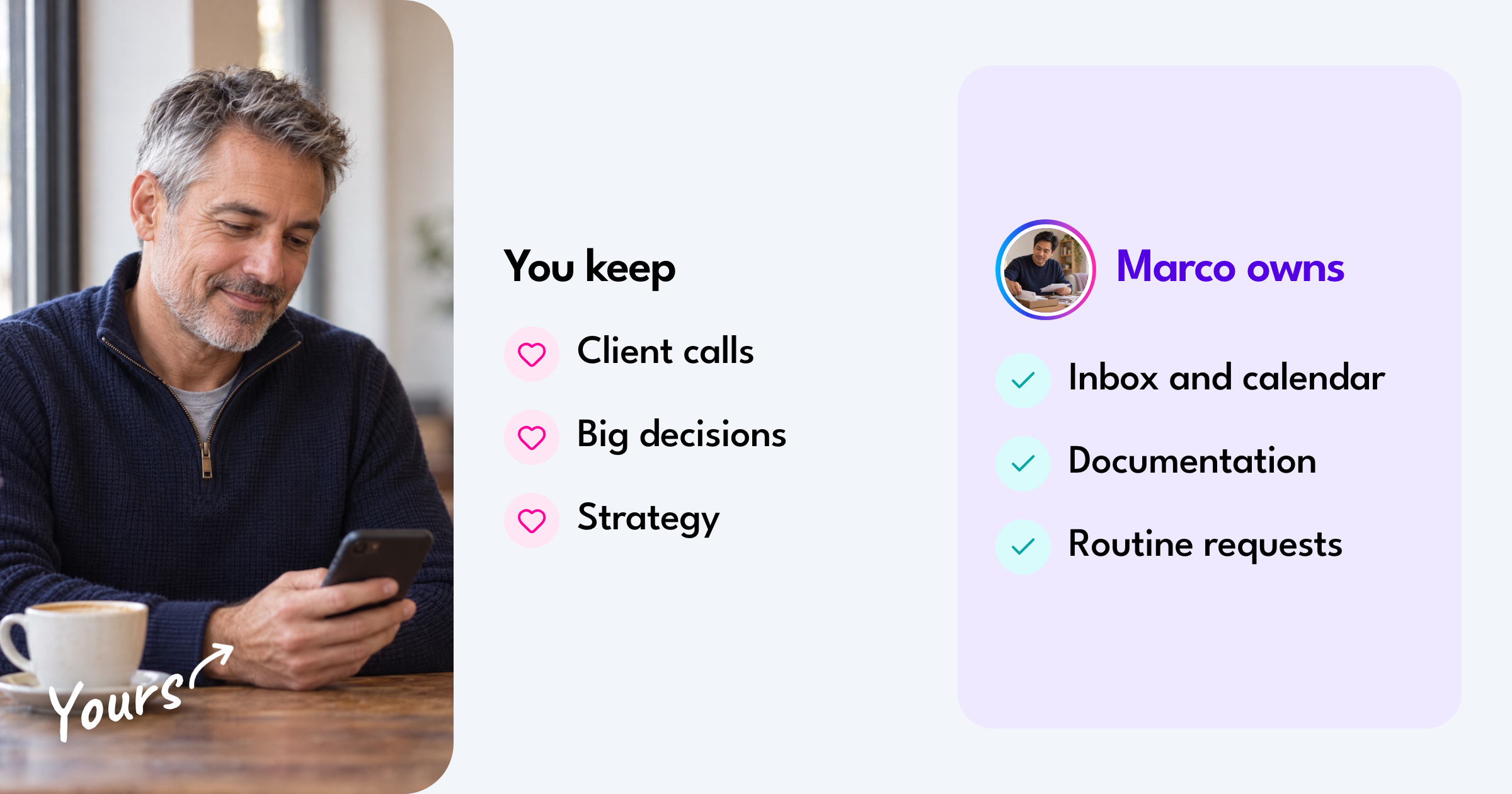
The solution to structural overload is not reorganizing your workday. It is transferring task ownership, which involves three clear steps:
- Identifying the recurring operational tasks that fall below the threshold of work requiring your specific expertise.
- Documenting the workflow context, including the basic rules, preferred formats, and tool access needed to execute the task reliably.
- Moving ownership completely to someone trained to execute those tasks consistently on your behalf.
When you transition from managing tasks to transferring ownership, the entire dynamic of your business changes. You are no longer checking off administrative items between client calls; your assistant monitors the inbox, coordinates scheduling, manages documentation, and processes routine requests entirely in the background.
This shift produces returns far beyond simple hours saved. When you eliminate constant context switching between high-stakes decisions and low-level execution, the quality of your strategic output increases dramatically. Understanding the financial reality behind this transition makes it clear that offloading operational work is a structural investment in your capacity, rather than a simple overhead expense.
What changes when the structure changes
When you fix the operational structure of your business, the primary benefit is not just a cleaner calendar. It is a fundamentally different mental state. Most content on delegation focuses strictly on immediate time savings, completely ignoring the massive second-order cognitive effects that occur when the operational layer is consistently handled.
Recovery of cognitive bandwidth
Constant, unmanaged mental load creates a state of cognitive scarcity, measurably dropping fluid intelligence and executive control. Carrying the mental weight of unresolved administrative tasks fatigues your brain. Removing that operational burden restores your cognitive bandwidth, enabling sharper analytical thinking.
Accelerated decision speed
Decision fatigue sets in when you force your brain to make dozens of minor operational choices throughout the day, such as picking meeting times, approving standard formats, or sorting inbox folders. By delegating routine mechanics, you are no longer mentally fatigued from admin. You reserve your mental energy for the high-impact decisions that actually drive business growth, allowing you to make them faster and more accurately.
Elevated strategic execution
Strategic projects require uninterrupted blocks of deep focus. When your operational layer is managed reliably by someone else, you can immerse yourself in long-term initiatives like product development, sales strategy, or key hiring. Your attention is no longer constantly interrupted by minor operational fires.
Improved client consistency
When an owner handles their own administrative tasks, customer communication often becomes inconsistent during busy periods. A dedicated operational partner ensures that inquiries are answered promptly, invoices are issued on schedule, and client touchpoints remain seamless regardless of how demanding your high-level schedule gets.
Identifying your delegation starting point
To make this transition, you must identify your delegation starting point. Look back at your current week and identify the three tasks that consumed the most time while requiring the least of your specific expertise.
These are your starting points for structural change. They may not be the easiest tasks to delegate, but they are the highest-leverage ones to remove from your plate first.
- For a service business owner, this often looks like managing the initial client inquiry inbox, scheduling consultation calls, and sending out standard intake forms.
- For a product seller, it might be processing standard refund requests, updating inventory logs, or formatting weekly promotional emails.
- For a consultant, it is usually transcribing meeting notes, formatting slide decks, and updating the CRM pipeline.
Once you map these tasks to your own situation, you are ready to take action. If you need a framework for exactly how to hand these over, review our comprehensive guide on how to delegate business tasks.
Trade productivity hacks for true operational support
Stop trying to fix structural bottlenecks by simply working later into the night. True operational freedom requires moving from being an overwhelmed owner-operator to acting as a strategic leader. The core issue is not whether you are capable of handling administrative tasks, but rather choosing the type of support that fundamentally improves how your business operates.
Magic provides vetted, professional virtual assistants who adapt to your specific tools and workflows. Rather than relying on temporary time-management tricks, you hand over your documented playbooks and Standard Operating Procedures (SOPs). This strategic partnership allows you to finally step away from the keyboard, allowing you to recover your time to focus on acquiring new clients and driving the revenue strategy of your business.
