


Choosing between a staffing agency and a virtual assistant company usually comes down to cost. Many staffing agencies quote lower hourly rates. They also charge placement fees and leave management to you, and you often pay again if a hire leaves. A virtual assistant company charges one predictable weekly rate and handles management and replacements for you.
TLDR:
- Staffing agencies hand the worker off to you after placement; VA companies stay involved with HR, training, and replacements.
- Agency direct-hire fees run 15-25% of first-year salary, while VA companies charge a predictable weekly or monthly rate.
- Choose a staffing agency for on-site or specialized roles. Choose a VA company for remote, recurring work where you want someone else to handle management.
- If a placed hire leaves after the agency’s guarantee period (typically 60 to 90 days), you often pay the agency again to replace them. A VA company like Magic finds a new assistant and hands over the work at no extra cost.
- Magic is a virtual assistant company that picks assistants from the top 0.5% of applicants. Virtual Assistant plans are $360 a week with no placement fee.
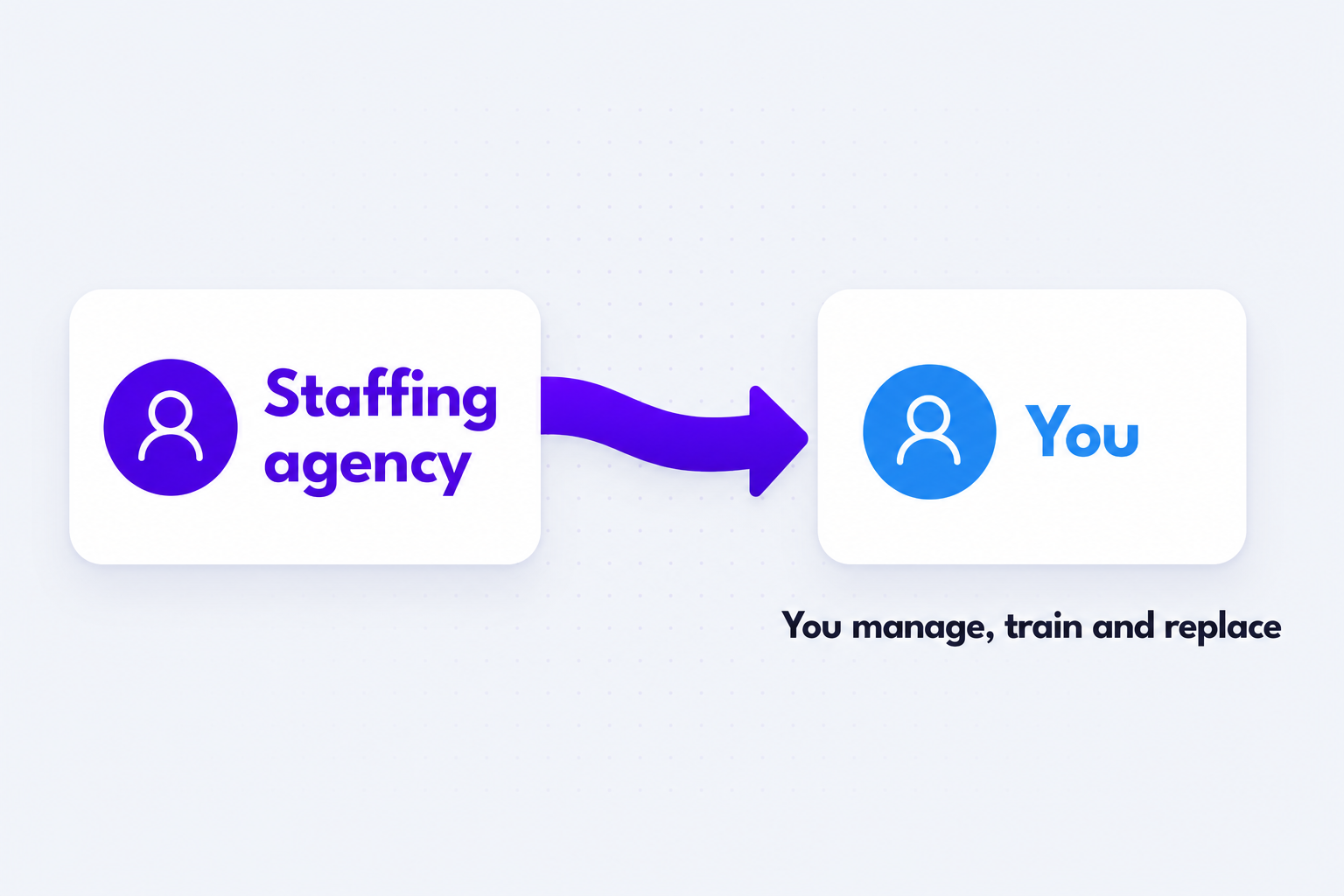
A staffing agency finds the worker and you manage them
A staffing agency acts as a recruiter on your behalf. It sources candidates, screens them, and presents the ones that fit your requirements. Once you select someone, that worker typically becomes your responsibility to manage day-to-day.
There are three common placement types:
- Temporary: Short-term workers placed for a set period or project
- Temp-to-hire: A trial arrangement where you can bring the worker on permanently after an evaluation window
- Direct hire: The agency finds a full-time candidate and hands them off to you permanently
Agencies charge either a flat placement fee or a markup on the worker’s hourly rate. For permanent placements, fees commonly run 15 to 25% of first-year salary. Once the placement is made, the agency’s role largely ends. You own the onboarding, the training, and the ongoing management from that point forward.
A virtual assistant company stays involved after the match
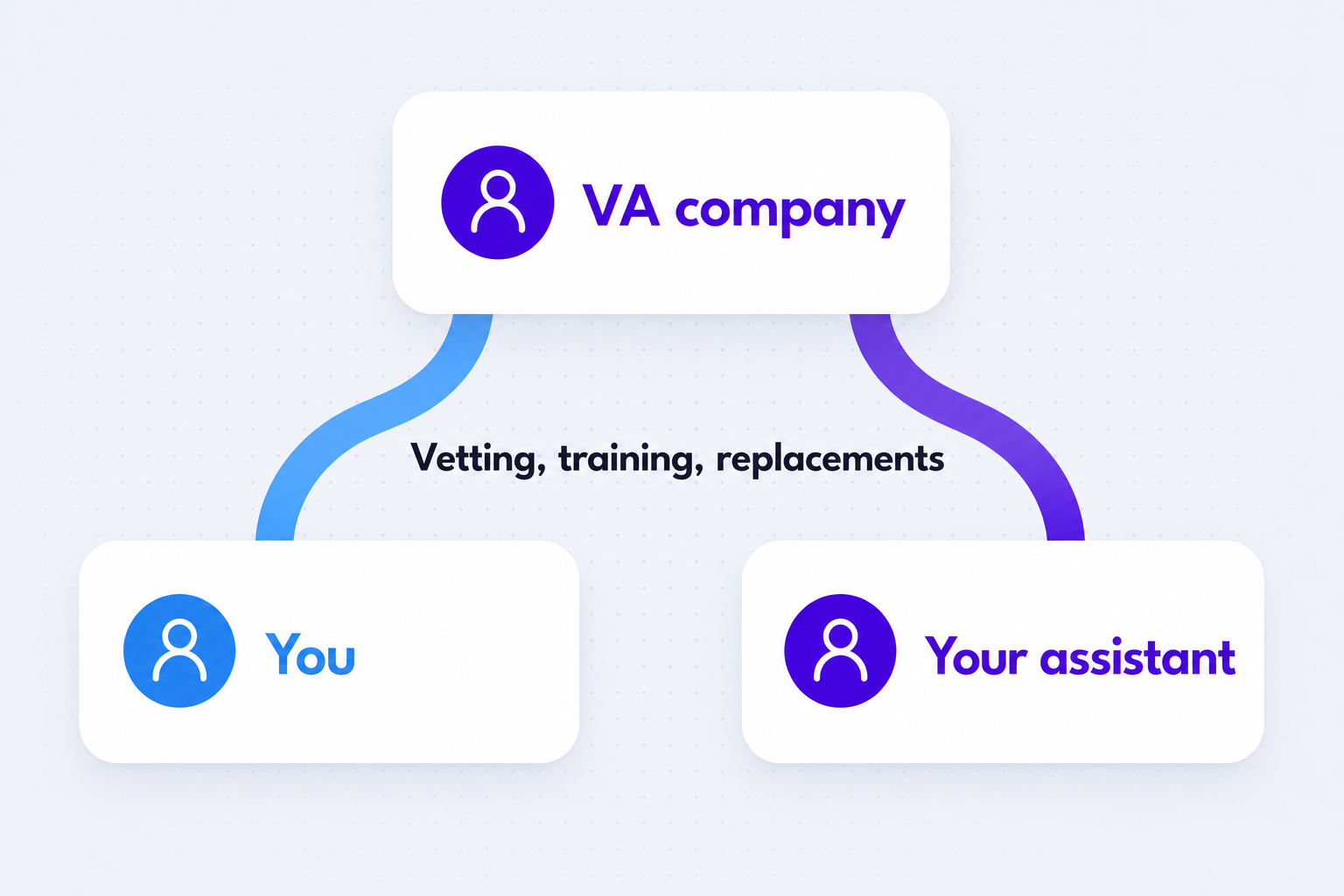
A virtual assistant company handles everything for you, including staffing. It sources, vets, and matches remote assistants to clients, and the management relationship stays with the company after placement. You direct the work, and the VA company handles HR, performance management and replacements.
Two main models exist within this category:
- Dedicated assistant: One assistant works exclusively with you, learning your preferences and processes over time.
- On-demand or shared-hours: You draw from a pool of assistants as needed, with no single person assigned to your account.
The dedicated model is better when you have ongoing work and continuity matters. You get an assistant that stays with you, learns and grows over time, and becomes responsible for your most important workflows. On-demand works better if you have mostly infrequent tasks that can be completed within an hour, and you don’t have enough work to give to someone working full-time.
Agencies hand off the worker, VA companies stay involved
Staffing Agency | VA Company | |
|---|---|---|
Who retains the worker | You (after placement) | The VA company |
Who handles training | You | The VA company |
Quality control | You | The VA company |
Contracts | Placement fee, then direct | Ongoing subscription or retainer |
Management burden | High | Low |
A staffing agency hands you the worker. The agency finds the person, you take them on, and you handle everything after that. A VA company stays involved. At Magic, that means Magic handles your assistant’s HR and pay, weekly coaching, and finding a new assistant if you ever need one.
That difference changes what you buy, as this hiring guide to modern outsourcing explains. With a staffing agency, you’re paying for access to a candidate pool. With a VA company, you’re paying for a managed ongoing service.
Agencies charge up front, VA companies charge a weekly rate
Staffing agencies and VA companies price their services differently, so an hourly rate alone doesn’t compare them. This can be confusing if you just look at the hourly rate and ignore everything else. Here’s the breakdown.
With a staffing agency, direct-hire placements typically carry a contingency fee in that 15 to 25% range noted above. Temporary staffing works differently: the agency pays the worker and bills you at a marked-up rate, with markup rates ranging from 20 to 100% depending on the role and industry. Neither fee includes onboarding, training, or any management after placement. You pay for those separately.
VA companies charge a flat weekly or monthly rate covering the assistant’s time plus ongoing management overhead. At Magic, pricing is $360 a week for a Virtual Assistant plan and $540 a week for an Executive Assistant plan, billed every four weeks. That covers vetting, matching, training and weekly coaching. No placement fee on top, and no separate cost if you need a replacement.
The practical difference: staffing agency fees are front-loaded, while VA company fees are ongoing but predictable. Agencies usually replace a hire for free only during a guarantee period of 60 to 90 days. If a placed hire leaves after that window, you often pay the agency again to find a replacement.
A VA company vets candidates before you meet anyone
With a staffing agency, you’re an active participant in selection. The agency screens a candidate pool and sends you a shortlist, but you conduct your own interviews, compare candidates, and make the final call. That hands-on control can feel reassuring, especially for specialized roles where you know exactly what you’re looking for.
The trade-off is time: you run the interviews yourself, and the first shortlist may not produce a fit. Running your own interviews adds days or weeks to the process, with no guarantee the shortlist produces a great fit on the first attempt.
VA companies vet and train assistants before you ever see a name. At Magic, assistants come from the top 0.5% of applicants. Every candidate passes resume screening, an online assessment that includes an English test, and a live video interview, then must pass Magic’s live training. Magic picks the best assistant for your needs, and you meet them and decide whether to work together.
You get started faster, and you decide whether to work with the assistant Magic picks. If the match isn’t right, Magic finds a new assistant at no extra cost.
A VA company manages your assistant after the match
After a staffing agency places someone, you manage them. You run the performance reviews, coaching and corrective conversations, and you find a replacement if they leave. The agency’s contract ends when the placement is made.
VA companies have to keep their assistants performing in order to keep their clients. They have a reason to coach and manage your assistant with you so the work gets done. At Magic, coaching and management includes weekly one-on-one coaching for your assistant, so you direct the work without running HR. If your assistant isn’t the right fit, Magic finds a new one and hands over the work. Executive Assistant plans also include 10 hours a week of Magic 24/7 for urgent work while your assistant is offline.
If you’re a founder or executive, you keep that management time every week after the hire.
When a Staffing Agency Is the Better Fit
Staffing agencies are the right choice in specific situations. If you’re hiring for a role that’s on-site, highly specialized, or where you want to bring someone on permanently long-term, the agency model works well.
A few scenarios where a staffing agency is probably the right call:
- You need a worker on-site at a physical location, like a warehouse, clinic, or job site
- You’re filling a technical role with narrow qualifications and want to run your own interviews
- You plan to bring the person onto your payroll directly and want full employer control from day one
- You’re building a local team and geographic proximity matters for the role
- Your industry has specific licensing or compliance requirements that benefit from a specialist recruiter
The staffing agency model also makes sense when a temp-to-hire arrangement fits your situation, where you want to assess someone before committing to a permanent offer. For remote admin or day-to-day work, that trial period isn’t usually worth it. But for a role where culture fit and in-person performance matter, it’s a reasonable structure.
When a Virtual Assistant Company Makes More Sense
A VA company fits best when the work is remote and recurring and you’d rather not manage the person yourself.

A few situations where this model fits well:
- You’re a founder or executive who needs to hire a virtual assistant for consistent admin, scheduling, or ongoing support but can’t afford to run a full hiring process.
- Your workload fluctuates and you want to scale hours or add assistants without new employment contracts each time.
- You need someone productive fast, with no time for onboarding.
- You want continuity built in, so if your assistant leaves, a replacement arrives without restarting the search yourself.
- The role is remote by nature, like inbox management, research, customer support, or bookkeeping.
A virtual assistant company handles hiring, training and replacements in one place. With a direct hire or agency placement, you start the search again if the person resigns.
A VA company has to earn your business every week, so it has a reason to keep your assistant performing. At Magic, there’s no long-term contract and you can cancel anytime.
Agencies fit on-site roles, marketplaces fit projects, VA companies fit recurring work
Freelance marketplaces like Upwork sit in a third category. Upwork gives you reach: you can find freelancers across many skills, from bookkeepers to developers, and hire on fixed-price or hourly contracts. On the free Basic plan, you post a job, review proposals, interview candidates and hire directly. Upwork’s Business Plus plan also sends you a pre-vetted shortlist of experts. This is based on publicly available information as of November 2026.
Upwork’s pricing is easy to compare. As of November 2026, Upwork’s client pricing page lists a 5% marketplace fee on Basic plan payments (3% for eligible US clients paying by checking account), plus a one-time contract initiation fee of $0.99 to $14.99. There’s no placement percentage. For a one-time project or a short burst of specialized work, that’s a good fit.
The fit changes for ongoing, recurring roles. On Upwork’s Basic plan, if a hire doesn’t work out, you post the job again and run the next search yourself. A VA company like Magic finds a new assistant and hands over the work at no extra cost.
Staffing Agency | VA Company | Freelance Marketplace | |
|---|---|---|---|
Vetting done for you | Partial | Yes | Optional on some plans |
Ongoing management support | No | Yes | Varies by plan |
Best for | On-site or specialized roles | Recurring remote work | Short-term or project work |
Risk if hire fails | You restart | Company handles it | You restart |
Six questions show which option fits you
Here are a few questions to ask yourself if you’re undecided:
- Is the role remote or on-site? On-site roles almost always fit a staffing agency. Remote roles fit VA companies and freelance marketplaces.
- How much time can you spend managing someone? If you have a dedicated HR function, a staffing placement may work fine. If you’re a solo founder or small team, ongoing co-management from a VA company is your best option.
- How fast do you need someone productive? A staffing search means interviewing candidates yourself. A VA company like Magic picks an assistant for you, so you meet one match instead of running a search.
- Is this a one-time project or recurring work? If it’s recurring, meaning you’ll have ongoing work for them every day, go with a VA company. Hiring someone to finish one project with a specific end often works better with a freelancer.
- How do you prefer to pay? Front-loaded placement fee or predictable weekly rate?
- What happens if it doesn’t work out? With a direct placement, you restart the entire process over again. With a managed VA company like Magic, they find a new assistant and hand over the work for you.
Also think about where your new hire will be joining and what you’ll expect them to do. A manufacturing company filling shift supervisors has a very different situation than a startup founder who needs to hire an executive assistant for inbox and calendar management.
Magic vets, trains and manages your assistant
Magic is the virtual assistant company model described throughout this article; see how Magic works in detail. Assistants are recruited, vetted, and trained before you ever get a match. Every candidate goes through resume screening, an online assessment with an English test, and a live video interview, and assistants come from the top 0.5% of more than 1 million applications.
Once matched, Magic coaches your assistant every week and handles HR and pay. You direct the work. If something stops working, Magic handles assistant replacement and hands over the work. More than 10,000 businesses have signed up and used Magic since 2015.
Virtual Assistant plans, with everything included in the service, are $360 a week and Executive Assistant plans are $540 a week. There’s no long-term contract, no placement fee, and nothing to pay until you start working with your assistant.
Your role and timeline decide between an agency and a VA company
Choose based on your role, your team size, and how fast you need someone working. Staffing agencies are a strong fit when the work is on-site or highly specialized and you want to run your own interviews. For remote, recurring work where continuity and low management overhead matter more, a VA company fits better. If you want to hire a virtual assistant, choose a company that specializes in virtual assistants.
Book a free call and Magic will pick the assistant who fits your work.
A staffing agency recruits and screens candidates, then hands them off to you as the employer. Training, management, and HR become your responsibility after placement. A virtual assistant company like Magic stays involved after the match: the assistant remains employed by the company, and performance oversight, coaching, and replacements stay off your plate. The core distinction is whether you’re buying access to a candidate or buying a managed ongoing service.
For recurring executive support, neither model holds up as well as a managed VA company. Staffing agencies hand off management to you after placement, and Upwork freelancers can disappear or raise rates without notice. Both put the search back on you if something goes wrong. A managed VA company like Magic includes co-management and guaranteed replacements, which matters more with ongoing work than a one-time project.
Magic draws assistants from the top 0.5% of a pool of 750,000-plus applicants, with every candidate going through live interviews and hand-matching by a person rather than an algorithm. Most staffing agencies present a shortlist that you then screen yourself through your own interview process. With Magic, the vetting is done before you see a name, and if the match falls through, the replacement process stays with Magic rather than restarting on your end.
A staffing agency fits best when the role is on-site, requires narrow technical qualifications, or you want to bring someone onto your payroll directly from day one. A virtual assistant company fits better when the work is remote and recurring (inbox management, scheduling, customer support, bookkeeping) and when you’d rather not run HR yourself. The simpler the question, the faster the answer: if the role requires physical presence, go staffing agency; if it’s remote and ongoing, a VA company removes far more friction.
Yes. Magic offers assistants trained for specific functions including customer support, bookkeeping, sales support, ecommerce, and HR tasks, not just general administrative work. Magic also serves specific industries like construction, professional services, transportation, and media, so the match can be scoped to the type of work rather than defaulting to a generalist hire.
Staffing agency direct-hire fees run 15 to 25% of a candidate’s first-year salary, paid upfront as a placement fee, and that number does not include training or management after the hire starts. VA companies charge a predictable weekly or monthly rate (Magic starts at $360 per week) covering the assistant, vetting, and co-management with no separate placement cost.
With a staffing agency, a departed hire often means you pay another placement fee and restart the search yourself. A VA company absorbs that disruption. At Magic, replacements are handled without restarting the process on your end or adding any extra charge.
A VA company is the faster path for remote work. Staffing agency searches typically take weeks once you factor in sourcing, your own interviews, and offer negotiations. Magic can have a matched assistant working within days, since vetting and matching happen before you ever meet a candidate.
Yes. A managed VA company lets you direct the work while the company handles HR, coaching, and performance oversight. Magic’s co-managed model means you give direction, and Magic handles the management layer, so you are not running reviews or corrective conversations on top of your actual work.
A temp-to-hire is a staffing agency structure where a worker fills a role temporarily while you evaluate them before committing to a permanent offer. It works well for on-site roles where culture fit and in-person performance need testing, but for remote admin or operational work, the added friction rarely justifies the trial period compared to a managed VA with a guaranteed replacement option.
With a staffing agency, quality control becomes your job once the placement is made: you run performance reviews, handle coaching, and manage any issues that come up. A VA company like Magic keeps quality control in-house after the match, with ongoing performance oversight and coaching handled on the company’s end.
Freelance marketplaces work well for bounded projects like a one-time data audit or a single research task, but they are a poor fit for ongoing work. There is no continuity built in: a freelancer can raise rates, go quiet, or take competing clients, and if the arrangement falls apart, the search restarts entirely on your end with no support.
VA companies perform best for recurring remote roles like inbox and calendar management, customer support, research, bookkeeping, scheduling, and sales support. These are exactly the roles where continuity matters and management overhead is the bigger burden, not finding the right candidate pool.
A dedicated assistant fits when you have consistent, ongoing work and want someone who learns your preferences and processes over time. On-demand or shared-hours models work better for low-volume tasks where you do not need a full-time person. If you find yourself repeatedly briefing someone new, a dedicated model will save you more time than it costs.
It changes significantly. A staffing agency placement shifts the full management burden to you (performance reviews, coaching, offboarding), which is manageable if you have an HR function but punishing for a solo founder or small team. A VA company keeps that layer off your plate, which is why the model tends to fit founders and executives better than the agency handoff model does.
