

Running a dropshipping store is frequently marketed as a completely hands-off business model. The pitch usually suggests that you simply find a winning product, turn on your advertising campaigns, and watch the margins accumulate while a third-party supplier handles all the physical inventory.
The reality of scaling an ecommerce store looks entirely different. If you want to survive the growth phase without burning out, bringing on a reliable virtual assistant for dropshipping is necessary. When your daily sales volume grows from a handful of transactions to hundreds of orders per day, the underlying mechanics of your business change drastically.
Companies can lose between 20 and 30% in revenue due to operational inefficiencies. When you choose to manage these repetitive details yourself, your attention inevitably shifts away from acquiring customers and optimizing your ad campaigns.
You become trapped in the backend of your own business, handling low-leverage tasks that stifle your momentum. That’s why it’s more efficient to hand off this massive workload to a dedicated professional so you can step out of the daily administrative cycle and return to operating as a true business owner.
The operational load behind every order
To understand the true cost of dropshipping operations, you have to look at the lifecycle of a single order and multiply it by your target monthly volume. High transaction volume is absolutely necessary to generate meaningful profit margins in this industry. However, scaling your marketing budget to achieve that volume without upgrading your back-office capacity creates an immediate and dangerous bottleneck.
The hidden cost of scaling
An unfulfilled order sitting in your Shopify dashboard is a financial liability until a valid tracking number is attached and the package is in transit. When you first launch, fulfilling a handful of daily orders feels completely manageable. You export the spreadsheet, fire off the details to your supplier, and trigger the shipping updates yourself.
But as your ad campaigns catch traction, that exact same routine becomes a massive liability. The administrative workload scales right alongside your sales. You quickly find yourself spending hours verifying shipping addresses, formatting spreadsheets, and cross-referencing confusing invoices from overseas suppliers. Every hour you spend playing catch-up in your backend is an hour pulled directly away from the tasks that actually generate revenue.
The breaking point for solo operators
Industry benchmarks indicate that solo operators typically hit a wall when processing around fifty to one hundred orders a week. Beyond that threshold, doing everything by hand goes from challenging to completely unsustainable. Recent ecommerce data shows that businesses relying on manual order processing incur 30% higher operational costs and face an average error rate of around 3%.
In a high-volume dropshipping environment, a 3% error rate translates to dozens of frustrated customers, incorrect shipments, and complicated supplier returns every month. When you push past your natural operational capacity, mistakes multiply. You miss invalid addresses. You overlook out-of-stock warnings from your sourcing agent. Those small errors immediately damage your customer satisfaction and ultimately threaten your standing with payment processors.
Reclaiming your growth trajectory
Taking yourself out of this cycle requires assigning these recurring steps to a dedicated professional. Having an assistant step in to coordinate with your suppliers, upload new products, and track the daily order changes the entire dynamic of your workload.
It drops your error rate, speeds up the fulfillment timeline, and removes you from the data-entry loop. Most importantly, it ensures the supply chain continues moving smoothly while your attention remains locked on finding winning products and improving your conversion rates.
Order processing and fulfillment coordination
Moving order data from your storefront to your supplier must happen with complete accuracy every single day. Whether you utilize automated platforms like AliExpress and CJdropshipping or route your orders manually through a private sourcing agent, the daily batching process is non-negotiable. Software tools and API connections frequently break, meaning human oversight is required to ensure no orders slip through the cracks.
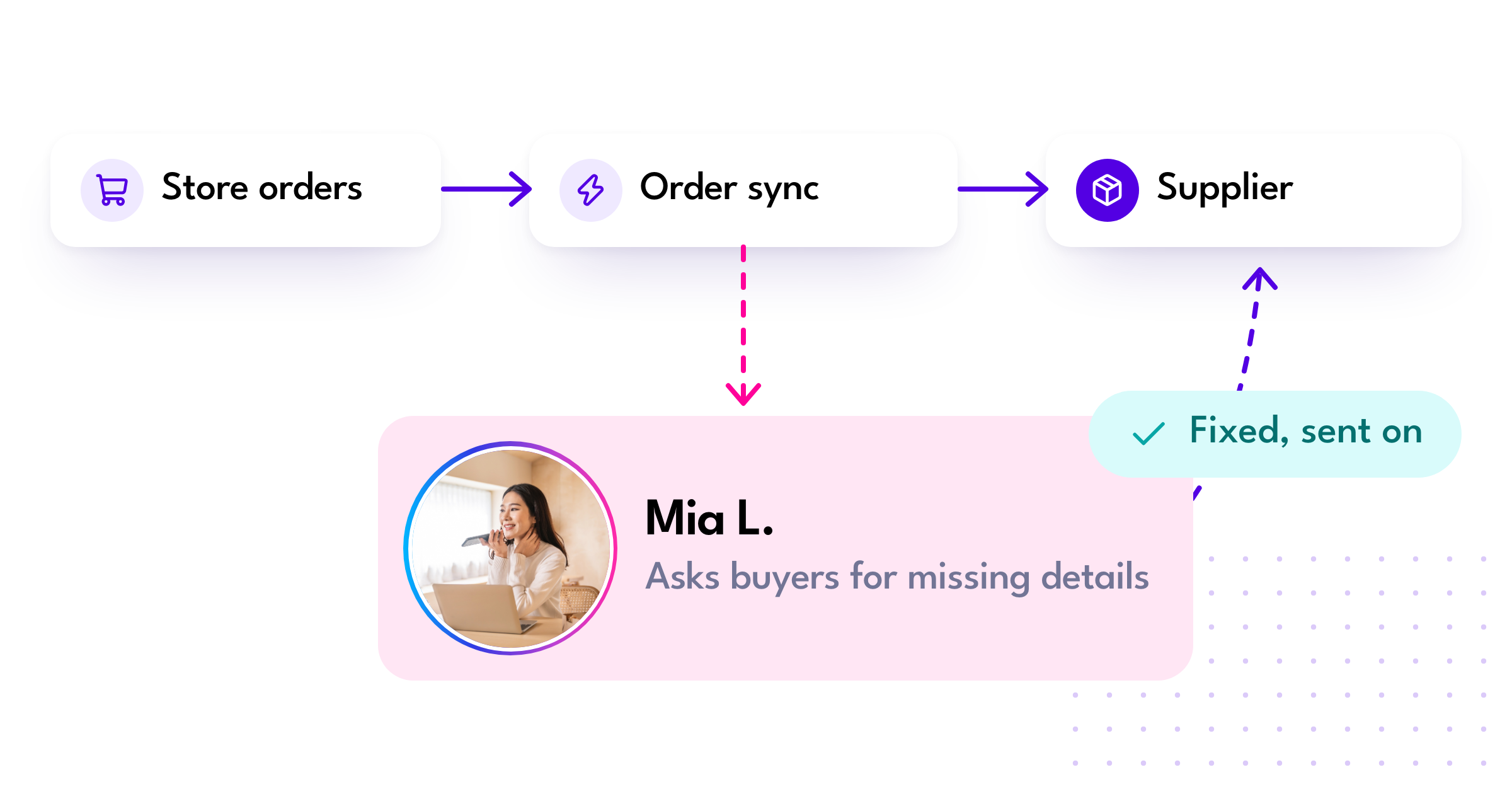
Your assistant logs in to your ecommerce platform, batches daily orders, and routes them to the correct supplier for processing. If an order arrives without an apartment number or is flagged by your fraud-detection software, the assistant pauses the fulfillment process and contacts the buyer for clarification. They handle these discrepancies quietly in the background, so your fulfillment timeline is not disrupted.
Once the supplier ships the item, the assistant retrieves the tracking data and updates the order status in your store. This specific action triggers the automated shipping confirmation email to your customer. When your order volume spikes during the fourth quarter or during major promotional events, this consistent daily maintenance prevents severe fulfillment backlogs. Customers receive their tracking numbers promptly, and suppliers get paid on time, which keeps your inventory moving without unnecessary interruptions.
Customer service operations
Customer service quality directly dictates the health of your merchant accounts. If response times lag and frustrated customers file chargebacks, your ability to process payments is put at risk.
Most dropshipping inquiries follow predictable patterns like tracking updates, cancellations, or address typos. You define the store policies and provide response templates.
Working from those guidelines, a customer service virtual assistant resolves routine issues, manages support tickets in helpdesks like Zendesk or Gorgias, and keeps buyers satisfied. They can also moderate social media comments to address shipping complaints promptly. Complex issues are only escalated to your desk when a situation requires your specific authority.
Supplier communication and coordination
The dropshipping model depends heavily on third-party reliability. Factories run out of stock, suppliers ship the incorrect variants, and logistics networks experience regional delays.
Managing these partnerships requires daily attention. Before you scale ad spend for a winning product, your assistant can verify the factory’s raw materials via WhatsApp or Skype. When tracking links show packages stuck at customs, they message the supplier to request an official investigation.
Handling this constant back-and-forth communication resolves fulfillment errors efficiently, meaning you no longer need to stay awake until the early hours of the morning just to align with overseas manufacturing time zones.
Store and listing management
A profitable product catalog requires constant upkeep to remain competitive. Suppliers frequently adjust pricing, discontinue specific variants, or release updated product photography. When you identify a product to test, you pass the raw supplier link to your assistant. They download the media files, remove the watermarks, and push the item live.
A Shopify virtual assistant or WooCommerce assistant handles these platform updates, from updating products and optimizing descriptions to basic search engine formatting. If wholesale costs rise, they update the retail price on your storefront to protect your profit margins, keeping your store professional without taking up your time.
Returns, refunds, and dispute coordination
Managing orders and returns takes a massive toll on your time because ecommerce return rates are consistently high. When a customer requests a refund for damaged goods, your assistant reviews the photo evidence, cross-references your policy, and initiates the process. They then open a ticket with your supplier to secure a credit or replacement.
Dispute coordination demands the same level of detail. When a buyer files a chargeback, the assistant gathers tracking links, screenshots of delivery confirmations, and customer correspondence to package into a response for the payment processor, recovering revenue that would otherwise be permanently lost.
What should stay with the store owner
While a well-trained assistant can efficiently manage the operational execution of your business, a virtual assistant is not a replacement for a founder.
Certain critical functions must remain entirely under your control to protect your store’s trajectory and legal standing. Drawing a hard line between business strategy and day-to-day operational tasks ensures execution remains strictly within documented capabilities.
Your role as the owner is to generate demand, establish the rules, and steer long-term growth, while your assistant’s role is to fulfill that demand according to your exact guidelines.
Sourcing strategy and supplier negotiations
Choosing your supply chain partners and establishing high-stakes vendor agreements requires your personal judgment. A virtual assistant can handle the daily back-and-forth communication with an active partner, but you must make the initial selection and negotiate the baseline costs. You are responsible for vetting the reliability of manufacturers, setting bulk order terms, and deciding when to transition from a general marketplace vendor to a dedicated private sourcing agent.
Product selection and testing strategy
The catalog layout, description updates, and image sourcing can be securely delegated, but deciding what your store actually sells must remain on your desk. You must analyze market trends and decide which products to test with your audience, which niches to enter, and which underperforming items to completely drop from your storefront. Your creative vision and market intuition dictate product selection, while your assistant handles the data entry to bring those choices to life.
Pricing strategy and margin optimization
Setting wholesale cost thresholds and determining retail prices are highly strategic financial decisions that directly affect your profitability. You must calculate your customer acquisition costs, account for payment processor fees, and define the net margin targets for each campaign. While an assistant can update retail prices across your store on command, you must establish the exact numbers and formulate the markdown or discount structures.
Marketing, ad spend, and positioning
Developing your brand voice, mapping out ad creatives, and managing your advertising budgets are growth-stage initiatives that belong strictly to the business owner. You must determine your target audience demographic, set campaign parameters on advertising networks, and decide how much capital to risk on a daily budget.
Assistants can support the reporting pipeline by pulling ad performance data or scheduling your social content calendar, but the high-level budget strategy must stay with you.
Full administrative account access
From an operational and security perspective, a virtual assistant should never have full administrative access to your store or your merchant accounts. You must use limited user permissions inside platforms like Shopify, Stripe, or PayPal and grant access only to the features required for their specific tasks. Keeping full ownership of password management systems, bank settings, and high-risk legal decisions protects your ecommerce asset from avoidable security exposure.
Setting up a VA for dropshipping operations
A successful operational handoff requires upfront documentation and clear instructions. You cannot simply grant an assistant access to your software and expect them to naturally understand your specific business logic. Because dropshipping involves multiple external platforms, suppliers, and customer touchpoints, a loose onboarding process will only introduce errors and create more interruptions down the line.
To turn your back-office tasks into a self-sustaining system, you need a structured transition plan.
1. Document store policies and communication templates
Before opening your live inbox, record your customer service guidelines in a shared hub. Write direct templates for transit delays, refund approvals, and missing package investigations. They must capture your brand voice well enough that an assistant can handle routine customer inquiries independently without guessing.
2. Record screen-share walkthroughs
Use screen recording software to capture short videos of yourself performing recurring tasks. Show exactly how you export daily orders to your supplier, correct a flawed shipping address, and format tracking numbers during uploads. This visual reference establishes an operational framework that runs smoothly without your constant involvement.
3. Establish restricted user permissions
Use your ecommerce platform’s user settings to grant limited access to the tasks your assistant will own. This includes viewing orders, updating product details, and managing customer profiles. Never hand over full administrative access or master credentials, as this can expose your business assets to security risks.
4. Provision helpdesk and supplier tool access
Set up restricted user profiles inside your customer service helpdesk and product research software. Once permissions are active, introduce your assistant to your primary sourcing agents and suppliers over your main messaging channel to ensure seamless daily handoffs.
5. Define a rigid escalation path
An assistant shouldn’t be forced to guess when a situation demands the owner’s judgment. Define what gets actioned versus what must be flagged immediately. Create a strict list of escalation triggers, such as formal legal threats, chargeback notices, or a supplier doubling wholesale rates without warning. This boundary protects your business from unnecessary friction while giving your assistant clear autonomy over routine tasks.
Scale your dropshipping operations with Magic
The true ceiling on your dropshipping store is dictated by your operational capacity. Scaling your marketing budget will ultimately break your business if your back office cannot handle the resulting surge in order volume. If you want to grow a sustainable brand, you need a support system that can absorb the friction of daily operations.
Magic connects you with skilled professionals who integrate directly into your existing software stack and take ownership of order processing, customer service, and catalog maintenance. By offloading these recurring tasks to a highly capable assistant, you reclaim the hours needed to test new products, optimize your advertising accounts, and negotiate better terms with your overseas suppliers.
Build the operational foundation your dropshipping store needs to scale efficiently and sustainably.
