


Building a global business means expanding across borders, which inevitably introduces the logistical friction of coordinating people who are awake at completely different times. Because of this reality, effective time zone management for remote teams is a hard operational requirement.
Without a reliable system to bridge these gaps, your daily operations will slowly grind to a halt. Urgent client messages slip through the cracks, and your internal team wastes valuable hours just trying to align their calendars for a simple sync.
To stop this recurring drain on productivity, you need a practical way to maintain continuous operations, without forcing your core team to work through the middle of the night.
The hidden operational cost of multi-time zone businesses
A majority of small businesses now launch with international clients or distributed teams from day one, driving the massive surge in cross-border operations. While reaching a global market accelerates growth, it introduces a hidden operational tax: coordination overhead.
When your business spans multiple time zones, you can no longer simply drop a meeting invite onto the calendar. Finding a window that works for both London and Sydney requires significant back-and-forth communication, which is a logistical hurdle that costs professionals hours of wasted time every week.
As your company scales, administrative friction can compound heavily on your bottom line by bleeding directly into your client experience and project momentum. Because urgent client requests inevitably arrive outside your local business hours, they sit completely unacknowledged until your core team logs on the next morning.
Internally, clumsy handoffs between overlapping regions produce information gaps that delay deliverables by a full day. These structural bottlenecks actively damage your client relationships and drain your overall productivity.
The coverage gap problem
Every multi-time zone business eventually hits the same operational wall: the coverage gap. There are critical hours in the global business day when inbound client requests demand attention, but your core team is already offline.
This daily downtime creates a massive disconnect between your availability and your clients’ expectations. Data from Above research reveals that over 80% of B2B buyers now expect real-time responses when they reach out.
When an urgent issue goes unacknowledged for 12 hours, you are essentially telling that international client they are a secondary priority. You cannot afford to let inbound inquiries wait until your local morning. Bridging this specific window of unavailability is the strongest practical argument for hiring a virtual assistant who operates in a complementary time zone.
How a VA in a complementary time zone extends your business day
Hiring a virtual assistant to operate during your off-hours functionally extends your business day. Instead of letting your operations pause while you sleep, you can pair specific global regions to achieve continuous coverage.
For example, a US-based business with clients in the Asia-Pacific region gains critical morning coverage by partnering with a VA working in the Philippines. Similarly, a UK-based business serving US clients secures late-afternoon and evening coverage by hiring a VA located in Latin America.
During these off-hours, your VA actively manages the operational front line. Instead of waking up to a backlog of urgent requests, you find your inbox managed and organized. They extend your capacity by taking ownership of several core tasks:
- Inbox triage and routing: Reviewing overnight emails, sending immediate personal acknowledgments to clients, and routing complex technical tickets to the appropriate department queues.
- Urgent issue escalation: Monitoring your support channels for high-priority account issues and flagging them for your immediate attention the moment your workday begins.
- Routine administrative execution: Processing standard data entry, updating CRM records, and generating daily reports, so the information is ready for your morning review.
- Customer service continuity: Answering basic product questions, processing routine billing updates, and handling standard account inquiries without forcing international customers to wait 12 hours for a reply.
This handoff model transforms your downtime into productive hours. You maintain momentum on routine work and deliver fast responses to global clients without burning out your local team.
Scheduling and calendar coordination across time zones
Scheduling across global regions is highly error-prone when done manually. Finding a single hour that works for teams in New York, London, and Tokyo can lead to a long email thread. And even after you agree on a time, sending an invite for the wrong time zone is one of the most frequent scheduling mistakes distributed teams make.
Daylight Saving Time (DST) creates an entirely separate layer of complexity. The United States, the United Kingdom, and Australia shift their clocks on completely different dates. A recurring team meeting that works perfectly in October will suddenly break in November.
How a virtual assistant solves calendar chaos
A virtual assistant can take complete ownership of your scheduling process to eliminate these manual errors. They do the heavy lifting of finding meeting times that actually work across multiple zones.
When the time is set, your VA sends calendar invites with the exact, correct time zone reference for every recipient.
They also manage the inevitable reschedules and maintain a master calendar that accounts for regional public holidays. As those tricky DST clock shifts approach, your VA tracks the regional changes and updates your recurring calendar invites proactively.
The tools required for time zone alignment
Your VA does not do this math in their head. They use specific scheduling tools to manage this workflow effectively and prevent the back-and-forth emails that drain your week:
- Time zone visualizers: Visualizing overlapping business hours across multiple regions to find the most viable meeting windows using tools like World Time Buddy or Timezone.io.
- Smart booking links: Configuring booking pages with automatic time zone detection for your external clients through platforms like Calendly or SavvyCal.
- Multi-zone calendars: Mapping internal team availability accurately by turning on secondary and tertiary time zone views directly inside Google Calendar or Outlook.
- Asynchronous schedulers: Delaying outbound messages so they land at the top of a recipient’s inbox during their local morning hours using the scheduled send features natively built into Gmail and Slack.
Communication handoff and continuity
Your distributed business requires a solid operational infrastructure to manage communication handoffs. If you lack a documented process for this transition, the window between your VA logging off and you logging on quickly becomes a black hole where critical context gets lost.
To maintain continuity across these time zone shifts, your VA must log the status of all active client conversations right before their workday ends. This structured handover allows you to pick up the thread immediately without wasting your first hour digging through the inbox to figure out what happened while you slept.
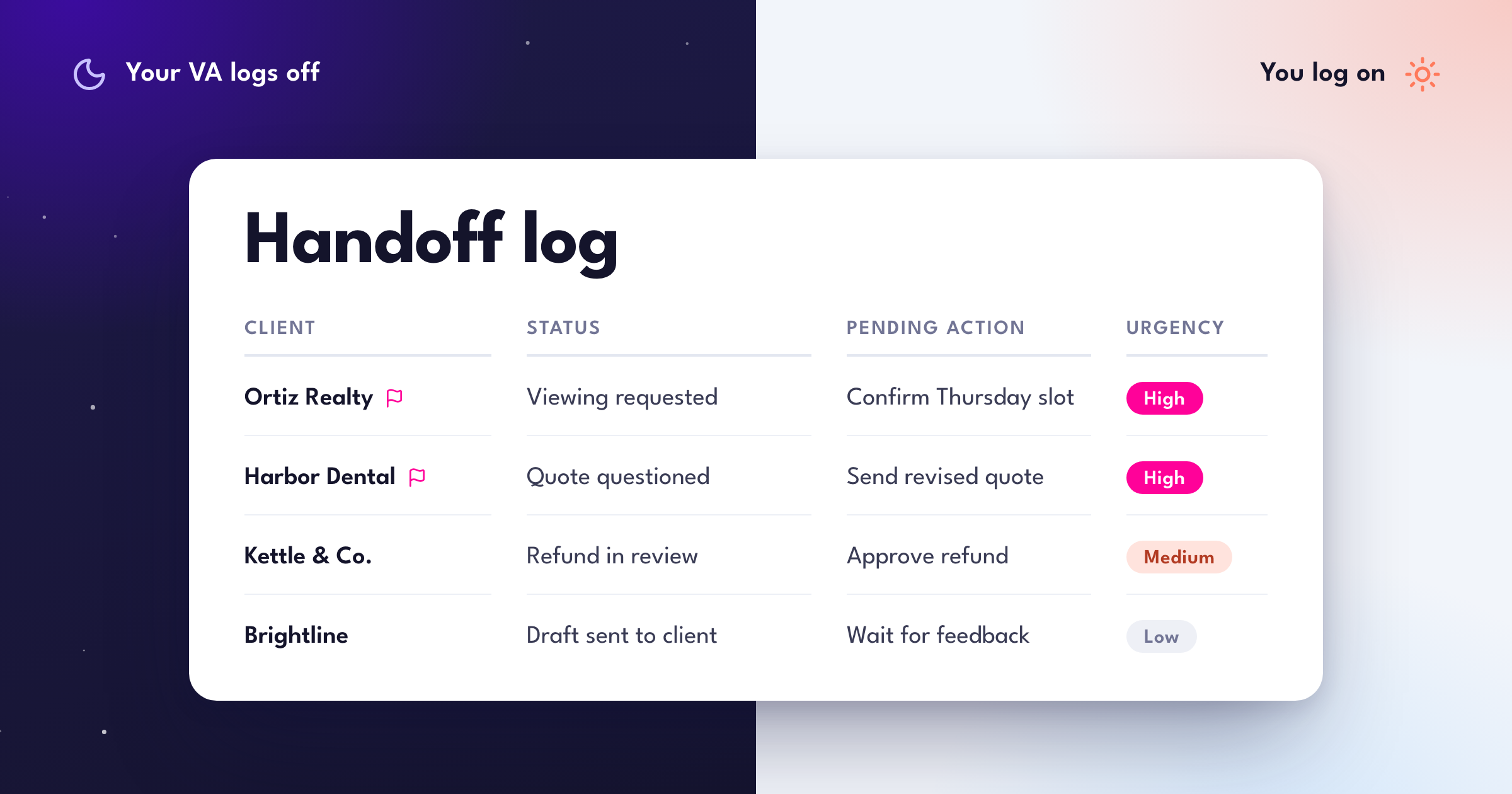
The most effective tool for this daily transition is a simple, standardized handoff log. Your VA should format this document using four specific columns: the client name, the current status of the inquiry, the pending action required from your team, and the overall urgency level.
When you log in for the morning, you simply open this document first to see exactly which fires need putting out and which emails can wait. Because your VA also flags any time-sensitive messages and follows a defined response protocol before logging off, no inbound communication sits unacknowledged. This seamless continuity keeps your global operations moving forward without interruption.
Time zone coordination for distributed internal teams
When team members and contractors operate across different time zones, someone needs to own the internal coordination. Delegating this operational oversight to a virtual assistant maintains momentum across distributed shifts through three main areas:
Managing overlapping availability and async handoffs
Scheduling cross-regional syncs often feels like a complex puzzle. A virtual assistant manages your calendar to pinpoint those rare overlapping hours when a live meeting is absolutely necessary.
For the majority of daily tasks, they ensure every project handoff includes complete context for the incoming shift. Instead of arriving at a vague request and waiting hours for clarification, your next team member logs in with all the background information organized and ready for immediate action.
Enforcing communication SLAs
Asynchronous work requires strict Service Level Agreements (SLAs), but those rules only succeed if someone actively enforces them. You cannot expect an engineer in Berlin to reply instantly to a project manager in California.
To manage this reality, your VA monitors internal communication channels to track whether requests receive responses within your agreed timeframes. They provide gentle nudges when a thread goes quiet, keeping minor questions from stalling a project for an entire day.
Securing deliverables before shift changes
A seamless transition requires all necessary assets to be accessible before the workday ends. As deadlines approach, the VA acts as a proactive traffic controller, identifying missing files or incomplete updates.
They ping the relevant team members during their local business hours to secure the required deliverables before those team members log off for the night. This prevents the classic remote work bottleneck where an incoming team member sits idle simply waiting for document access.
Maintaining this coordination infrastructure through a VA prevents administrative friction from slowing down your core operations. If you want to streamline these internal workflows further, review our best practices for managing a high-performing remote team.
Training a VA for multi-time zone operations
Setting up a virtual assistant for multi-time zone operations requires deliberate documentation before they take their first shift. To ensure seamless off-hours coverage, focus your onboarding on four critical operational areas:
- Documenting core time zones and operating hours. Map out active client regions, internal team shifts, and regional holidays so your VA understands exact operational windows.
- Defining urgent escalation protocols. Set clear guidelines for what constitutes a true emergency, who to contact during off-hours, and which channels to use when immediate intervention is required.
- Standardizing communication templates. Provide channel-specific tone guidelines and pre-approved response templates to maintain brand consistency across email, live chat, and support tickets.
- Establishing a daily handoff log. Create a standardized sheet to track client name, inquiry status, required action, and urgency level. This document serves as the single most important asset in a multi-time zone arrangement, keeping work moving smoothly between shifts.
Because this role depends on precise coverage windows, establishing a reliable tracking system is equally essential. Review our guide on how to track virtual assistant hours to maintain full visibility across your distributed shifts.
What multi-time zone VA support cannot replace
A virtual assistant providing off-hours coverage offers essential operational and administrative leverage, keeping your inbox managed and your calendar aligned across regions. However, off-hours execution should not be confused with localized executive authority.
To build an effective distributed model, maintain clear boundaries around tasks that require dedicated regional leadership:
- Direct team leadership: Conducting formal performance reviews, managing compensation negotiations, and resolving sensitive internal conflicts require managerial authority and organizational trust rather than administrative facilitation.
- Strategic decision-making: While VAs excel at executing documented processes, evaluating complex trade-offs, pivoting go-to-market strategies, or taking on organizational risk requires executive judgment and accountability that cannot be templated.
- High-stakes account management: A virtual assistant can triage inbound messages and flag urgent inquiries, but closing major enterprise renewals, saving at-risk client accounts, or negotiating contract terms demands executive presence and immediate decision-making authority.
- Localized cultural and legal nuance: Navigating regional employment laws, tax compliance, or delicate regional negotiation subtleties requires deep, lived local context that extends past general cross-border administrative coordination.
- Specialized technical execution: Resolving complex software architecture failures, drafting legally binding contracts, and conducting formal financial audits require licensed domain expertise and technical specialization rather than procedural task management.
Eliminate time zone friction with Magic
Managing cross-border operations does not require working around the clock or burning out your core team. Pairing your company with vetted virtual assistants positioned across complementary time zones allows you to establish true operational continuity without the expense of opening overseas offices.
From off-hours calendar coordination and structured daily handoffs to rapid client triage, Magic provides trained VAs ready to keep your business moving while you sleep.
Extend your operating hours and protect your team’s focus. Hire a Magic virtual assistant today!
