


Outsourcing can be one of the smartest moves a growing business makes, a way to cut costs and lift productivity at the same time. It takes some planning to get right, so here’s what you need to know before you start.
As a business owner, you have a lot on your plate. You want to make strategic decisions, but you may find yourself spending too much time on admin work that pulls you away from bigger priorities. Outsourcing is a practical way to cut costs, improve productivity, and grow revenue.
From administrative tasks to customer support, you can hand various functions to an outsourcing partner. That frees you and your team to focus on the core work that moves the business forward.
So, what is outsourcing? Let’s look at the definition, the different types, the benefits, and how to choose a partner. By the end, you’ll have what you need to make an informed decision.
- Outsourcing means hiring a third-party company to handle work for your business. It suits any size, from small and mid-sized enterprises (SMEs) to startups and large companies.
- From administrative tasks to customer support, you can delegate functions your in-house staff would otherwise manage.
- Insourcing and outsourcing each have pros and cons. The right choice depends on your needs, budget, and resources.
What is outsourcing?
Outsourcing is the practice of hiring a third party to handle tasks or provide services your in-house team would usually do. In most cases, it fills work gaps or adds extra help for fluctuating workloads.
It’s a big and growing market. The global business process outsourcing market is projected to grow from about $358.6 billion in 2026 to nearly $695.8 billion by 2033, and companies of every size are taking part, from SMEs and startups to large enterprises.
With outsourcing, leaders and their teams can focus on the core aspects of the business while the work still gets done, which opens the door to faster growth and development.
Outsourcing vs. insourcing: what’s the difference?
To round out what outsourcing means, it helps to compare it to insourcing. The difference comes down to who does the work and where.
Insourcing means assigning a task or project to a person or department inside your business. Outsourcing means handing that work to an outside person or company not affiliated with your business.
Both approaches have pros and cons, and the right one depends on the job. For example, a company with an established marketing team might insource the launch of a new product, since employees know it better than anyone outside the company. Meanwhile, that same business might outsource accounting or admin work so the in-house team can focus on higher-value activities.
Read more on this topic: Outsourcing vs. Insourcing: Which is Best for Your Business?
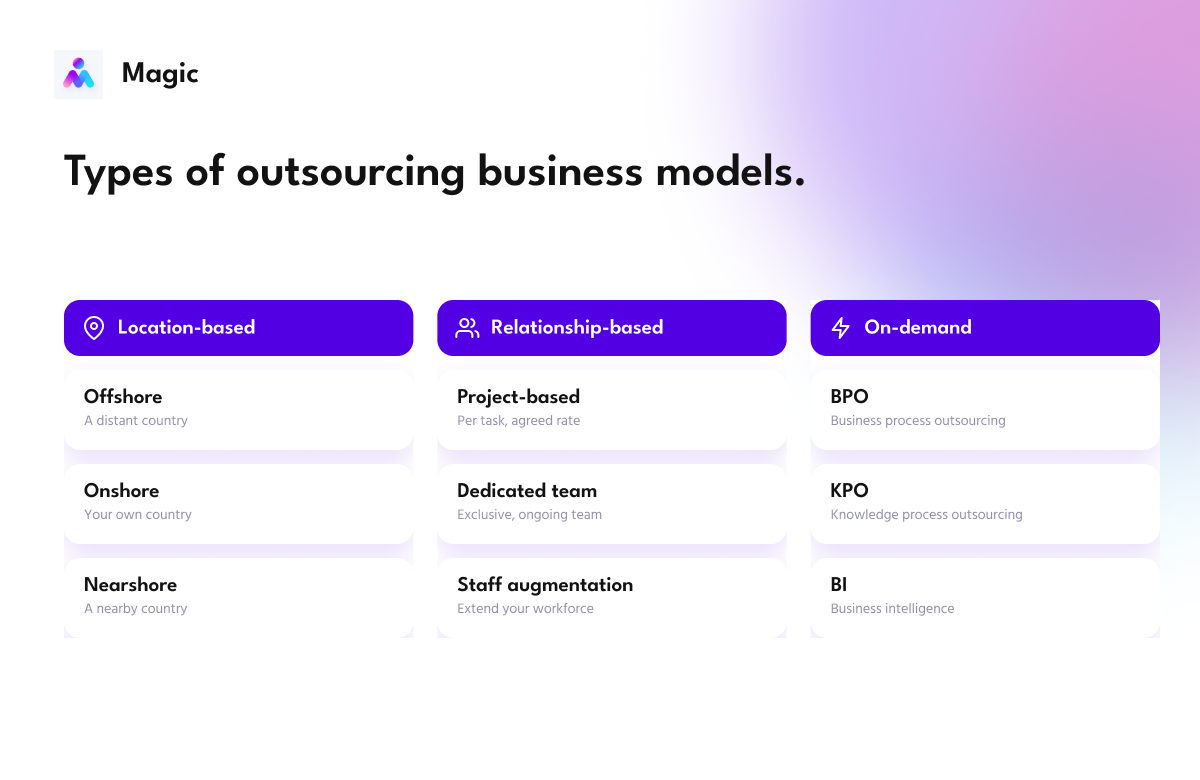
Types of outsourcing business models.
There’s a wide range of services you can outsource, and just as many ways to structure the arrangement. Here are the main models.
Location-based outsourcing business models.
When people hear “outsourcing,” many picture hiring workers in another country. That’s just one option. There are three common location-based models: offshore, onshore, and nearshore.
Offshore model.
Offshore outsourcing is when a business hires a firm in a distant location to meet specific needs and save money. Working with an international team takes some adjustment, but many owners prefer it for the access to global talent and the competitive edge it brings.
Onshore model.
An onshore model is when the outsourcing company is in the same country as the business it works with. This lets you work with people in your own market, which matters when the work depends on local knowledge. For example, a business might outsource HR in its own country so the provider understands local labor laws and can hire in the same area.
Nearshore model.
A nearshore model uses a provider in a nearby country or region. For some businesses it’s the best of both worlds: you reduce costs with an international team while still working with people who share similar time zones and culture.
Relationship-based outsourcing business models.
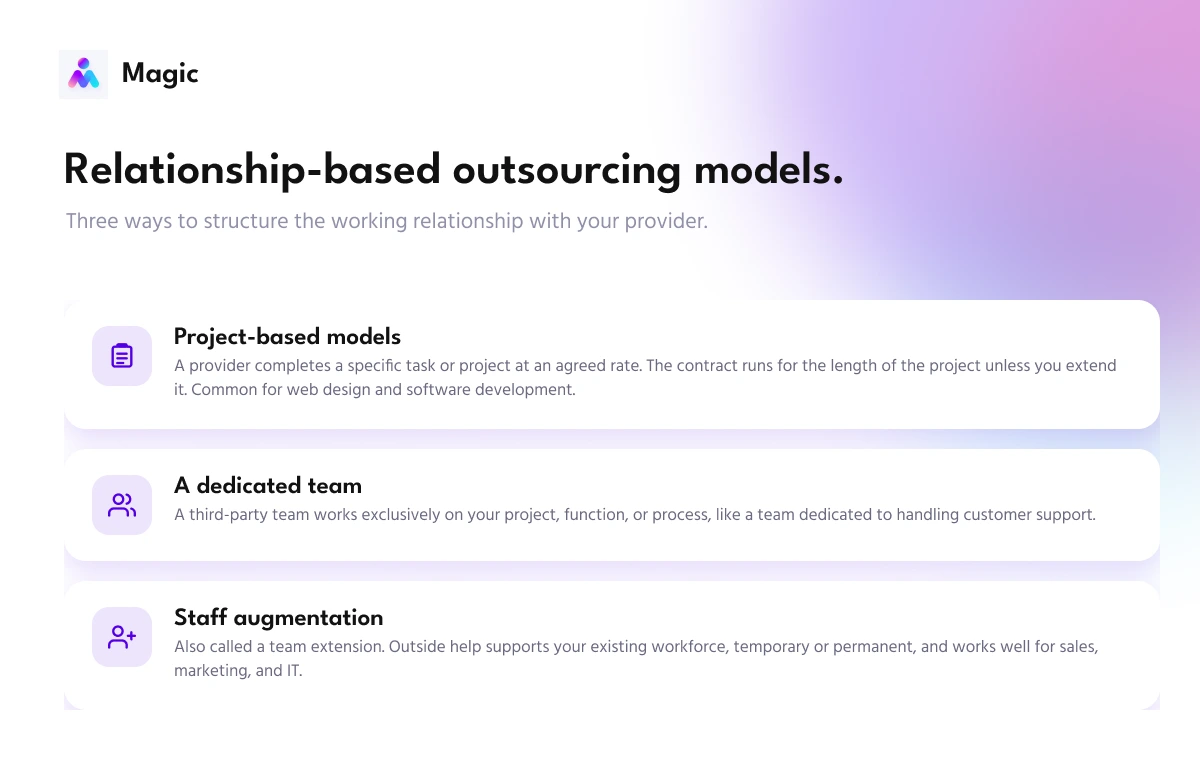
These models are defined by the working relationship between a business and its provider. There are three common types.
Project-based models.
In a project-based model, a business hires a firm to complete a specific task or project at an agreed rate. The contract runs for the length of the project unless both parties extend it. Common examples include web design and software development.
A dedicated team.
A dedicated team is one of the most common models. A business hires a third-party team to work exclusively on a specific project, function, or process. For example, many businesses use a dedicated team to outsource customer support.
Staff augmentation.
Also called a team extension, staff augmentation is when a business brings in outside help to support its existing workforce. It can be a temporary fix for busy stretches or a permanent way to fill gaps, and it works well for sales, marketing, and IT.
On-demand outsourcing business models.
In these models, a business hands a core operational process to an outsourcing firm. Here are three examples.
Business process outsourcing (BPO).
Business process outsourcing (BPO) is a popular model where a business shifts tasks from its internal team to a third party. BPO covers essential functions such as sales, customer support, accounting, and IT.
Knowledge process outsourcing (KPO).
Knowledge process outsourcing (KPO) covers services that require technical knowledge or problem-solving. Businesses tap a highly skilled, specialized workforce that costs less than building the same capability in-house.
Business intelligence outsourcing (BI).
Business intelligence outsourcing (BI) is when a business turns to an outside company for data analytics and reporting. The goal is usually to find insights or new opportunities that lead to better decisions.
5 main benefits of outsourcing.
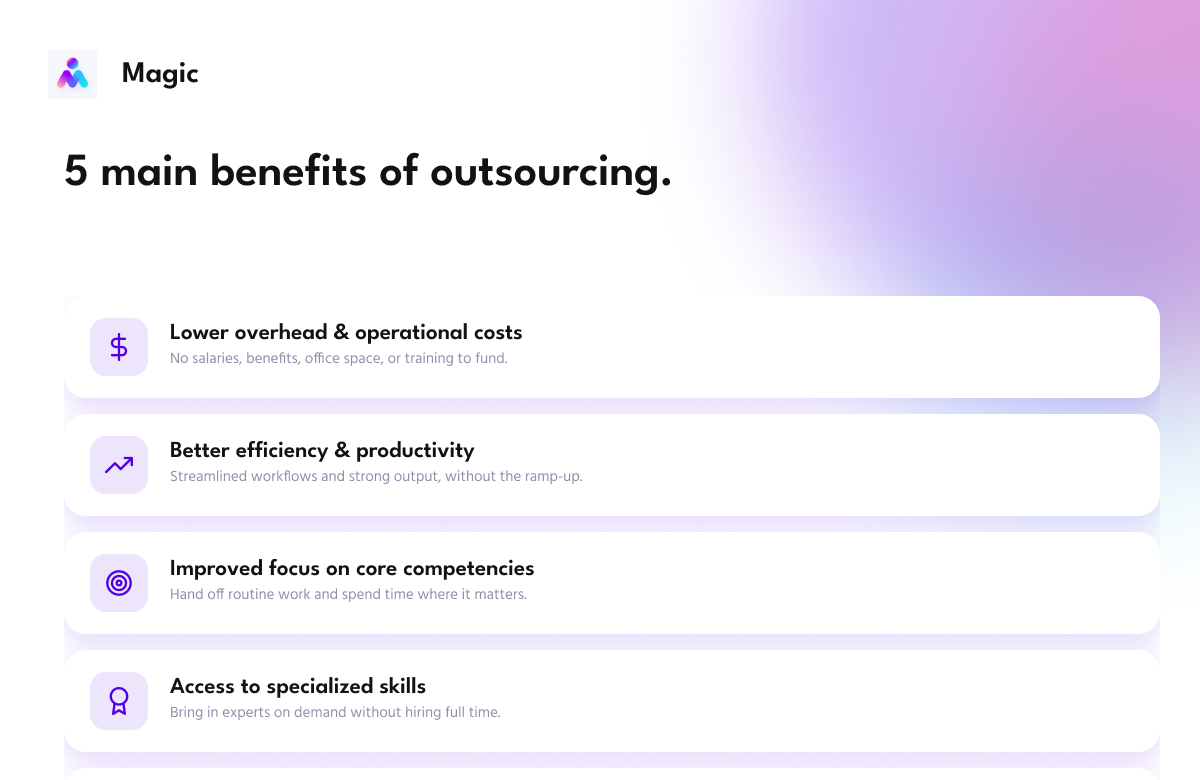
Outsourcing offers real advantages, especially if you want to accelerate business growth. Here are the five that matter most.
1. Lower overhead and operational costs.
Cost savings are one of the top reasons companies outsource, and the numbers are significant: businesses save anywhere from 20% to 70% on operational costs depending on the function and location. Hiring is faster, and a remote team doesn’t need office space, equipment, benefits, or training. You can also engage help hourly or by project to avoid paying for capacity you don’t need.
2. Better efficiency and productivity.
Outsourcing helps you improve your processes and get more done without sacrificing quality. A good provider streamlines workflows and delivers strong output, which gives you an edge in your market.
3. Improved focus on core competencies.
With the right support in place, you and your team can focus on the work that matters most. Handing off routine functions frees up time to improve the customer experience or grow the business, instead of getting buried in day-to-day admin.
4. Access to specialized skills and expertise.
Cost is no longer the only driver. In recent surveys, access to skilled talent has become one of the leading reasons companies outsource. With so many models available, you can bring in people who specialize in accounting, sales, IT, and more, and offshore or nearshore options widen the talent pool even further.
5. Flexibility and scalability.
Because outsourcing usually costs less than insourcing, you can scale up or down as your needs change without a long-term commitment. That agility helps your business adapt to shifting conditions, trends, and challenges.
Outsourcing and AI: a note for 2026.
Outsourcing today isn’t just about handing off tasks. The strongest providers pair skilled people with AI tools to work faster and smarter, whether that’s drafting reports, handling routine tickets, or surfacing data insights.
The goal isn’t to replace the human, it’s to give a capable person the tools to do more, with someone still in the loop to check quality. When you evaluate a partner, ask how they use AI and where people stay involved.
How to choose the right outsourcing company.
Once you decide to outsource, the next step is picking the right partner, one that fits your needs and helps you reach your goals.
Start by defining the services you need, such as a virtual assistant, sales, bookkeeping, or customer service. Then figure out how many people you need and for how long.
Next, look for firms within your budget that offer those services, and check their track record on delivery times, error rates, and customer satisfaction.
Finally, choose a company whose communication style fits yours. Clear communication on both sides is what makes the relationship work, so confirm your provider values confidentiality, data protection, and accountability.
The best part: once you find the right partner, you can adjust, extend, or scale your outsourced services as your business grows.
Magic’s dedicated outsourcing services for your business.
Now that you know how outsourcing works, you can see how to put it to work in your own business. It’s a smart way to save time and grow without the risk and overhead of expanding your in-house team, with benefits like access to top global talent, greater flexibility, and real cost savings.
Start with Magic’s dedicated outsourcing services to transform your business processes, including customer support, sales, general admin, marketing, and more. Hire a remote team in less than a week and pay as you go, with no contracts or hassle.
Get a flexible remote workforce across virtual assistance, sales, customer support, accounting, and AI. Every Magic worker goes through a multi-step screening process, so you get top talent and quality results.
Get started now to grow your business.